
Sweepstakes Casino Payouts in 2026: How to Redeem Sweeps Coins and Get Paid
 Available in US
The most common complaint I hear from new sweepstakes casino players isn’t about game quality or bonus terms. It’s about payouts. Either they didn’t understand how payouts work, hit an unexpected requirement they didn’t know existed, or got confused about why their SC balance wasn’t immediately cashable. After nine years of tracking redemption processes across dozens of platforms, I can tell you with confidence: the mechanics aren’t complicated, but they’re not intuitive, and most platforms don’t explain them well upfront. This guide covers the 2026 redemption standard, every major payout method, timing realities, tax obligations, and the most common things that go wrong. Read it before you hit the cashier for the first time.
The 2026 outlook for SC redemptions is substantial: total redemption volume is projected at $8.5 to $9.5 billion, based on analysis from EKG and operator data compiled by rg.org. That’s the total cash value being paid out to sweepstakes casino players across the US market. The scale tells you these systems work at a large scale — billions of dollars moving from platforms to player bank accounts is not a marginal activity. The question is how your specific redemption moves through the process, and how long it takes.
The 2026 Redemption Standard: 1 SC = $1, 50 SC Minimum
The sweepstakes casino industry has largely standardized on two redemption parameters that every player needs to know before they spend time accumulating SC balances.
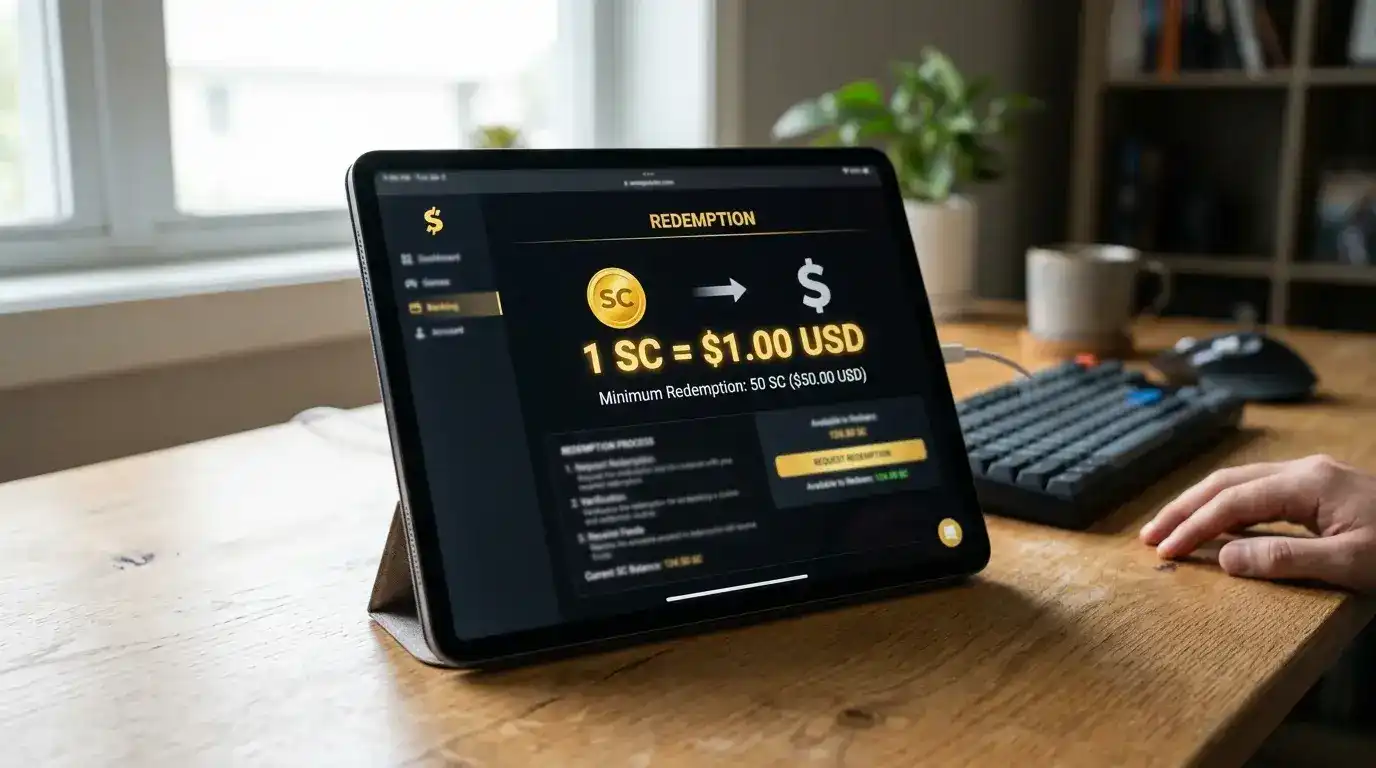
First: the exchange rate. One Sweeps Coin equals one US dollar. This has become the de facto industry standard among established platforms, and it simplifies the math considerably. If you have 100 SC in your balance, you have $100 in redemption-eligible value. No conversion calculations, no opaque exchange ratios. When I started covering this space, some platforms used proprietary rates (500 SC = $1, 1,000 SC = $5) that obscured the real value of balances. The move to 1:1 is a genuine improvement in transparency.
Second: the minimum redemption threshold. Most major platforms require a minimum of 50 SC to submit a redemption request. This equals $50 in cash value. Some platforms set the minimum slightly lower (25 SC) and a smaller number set it higher (100 SC), but 50 SC has become the standard that most players should plan around. Before you start accumulating SC on a new platform, confirm their specific minimum — it’s always disclosed in the rewards or cashier section.
VGW’s own operational data illustrates the scale of the redemption economy. The company paid out $2.83 billion in prizes in FY2023-24 alone, an increase from $2.2 billion the prior year. That’s one operator’s payout volume — the largest in the sector, but not the only one. The overall ecosystem’s $8.5 to $9.5 billion 2026 projection represents a redemption economy that, in terms of absolute cash flow, rivals the payout operations of major regulated gaming companies.
The payout ratio — the percentage of Gold Coin purchase revenue returned as SC redemptions — runs between 68% and 72% for the overall market in 2026 projections. This metric is conceptually similar to an RTP percentage but calculated differently, across the entire revenue-to-redemption cycle. A 70% payout ratio means that for every $100 in Gold Coin purchases across the market, approximately $70 returns to players as SC redemption value. The remaining $30 covers operator costs and profit. Understanding this ratio helps contextualize what’s happening economically when you accumulate and redeem SC.
One important nuance on the 50 SC minimum: it applies to your eligible balance, not your total SC balance. SC you’ve received but haven’t yet met playthrough requirements on isn’t eligible for redemption until the playthrough condition is satisfied. If you have 60 SC in your account but 30 of those are still subject to wagering requirements, your eligible balance is only 30 SC — below the redemption minimum. This trips up players who assume their displayed SC balance is fully available for cash-out. Check the “eligible for redemption” figure in your account, which most platforms display separately from total SC balance.
Payout Methods: ACH, Skrill, Gift Cards, and More
Every major sweepstakes casino offers multiple payout methods, but availability varies by platform and sometimes by state. Understanding which method is right for your situation before you initiate your first redemption saves time and potential frustration.
ACH bank transfer is the most widely available and most commonly used payout method. ACH (Automated Clearing House) moves money directly from the operator’s bank account to yours. It’s free, it settles to your account in two to five business days after the platform approves the request, and it requires no third-party account. The downside is speed — if you want your money faster than five business days, ACH isn’t it. The upside is universality and the absence of fees: almost every US bank accepts ACH transfers, and platforms don’t charge for this method.
Skrill is the faster alternative. Skrill is an e-wallet service (similar to PayPal in structure but with a different user base and better integration with gaming platforms). Platforms that offer Skrill as a payout method can process same-day or next-day transfers once the redemption request is approved. The catch is that you need to have a Skrill account, and Skrill charges fees on certain transactions and conversions. If you redeem frequently in smaller amounts, Skrill fees can erode your effective payout value. For large, infrequent redemptions, the speed advantage typically outweighs the fee friction.
PayPal has historically been offered by some sweepstakes platforms but has become less available as PayPal has restricted gaming-related transactions. Platforms that offered PayPal redemptions a few years ago have often replaced them with Skrill or direct ACH. Always check current payout options on the platform’s cashier page rather than assuming based on what you read elsewhere — payout method availability changes periodically.
Gift cards are a common payout option that surprises players who haven’t encountered it before. Platforms like Amazon, Visa, and major retailers allow sweepstakes casinos to fulfill redemptions through their gift card programs. For players who don’t want a cash-equivalent deposited in a bank account — perhaps for personal budgeting reasons — gift card redemptions can be useful. The denominations available vary, minimum redemption amounts for gift cards sometimes differ from cash minimums, and delivery is typically digital (an email code) within 24 to 48 hours of approval. The effective value is 1:1 with SC, though some platforms charge a small processing fee on certain gift card types.
Physical check by mail remains an option at a few platforms — the old-school sweepstakes payout method. Processing and mailing time means a 10 to 21 day wait from request to check arrival, and you then need to deposit it. This method exists primarily for players who don’t have digital payout options or who prefer paper documentation. It’s rarely the optimal choice for most players.
Cryptocurrency payouts are available at a small number of platforms — primarily those with connections to the crypto-native gaming community. Stake.US, for example, is the sweepstakes-format product of a crypto-first gaming brand. Where crypto redemptions are available, they can combine the speed advantage of Skrill with the absence of traditional banking infrastructure. But most mainstream sweepstakes platforms don’t offer crypto redemptions, and the volatility of crypto values introduces a risk element that ACH and gift card options don’t carry.

How Long Does a Sweepstakes Casino Payout Take?
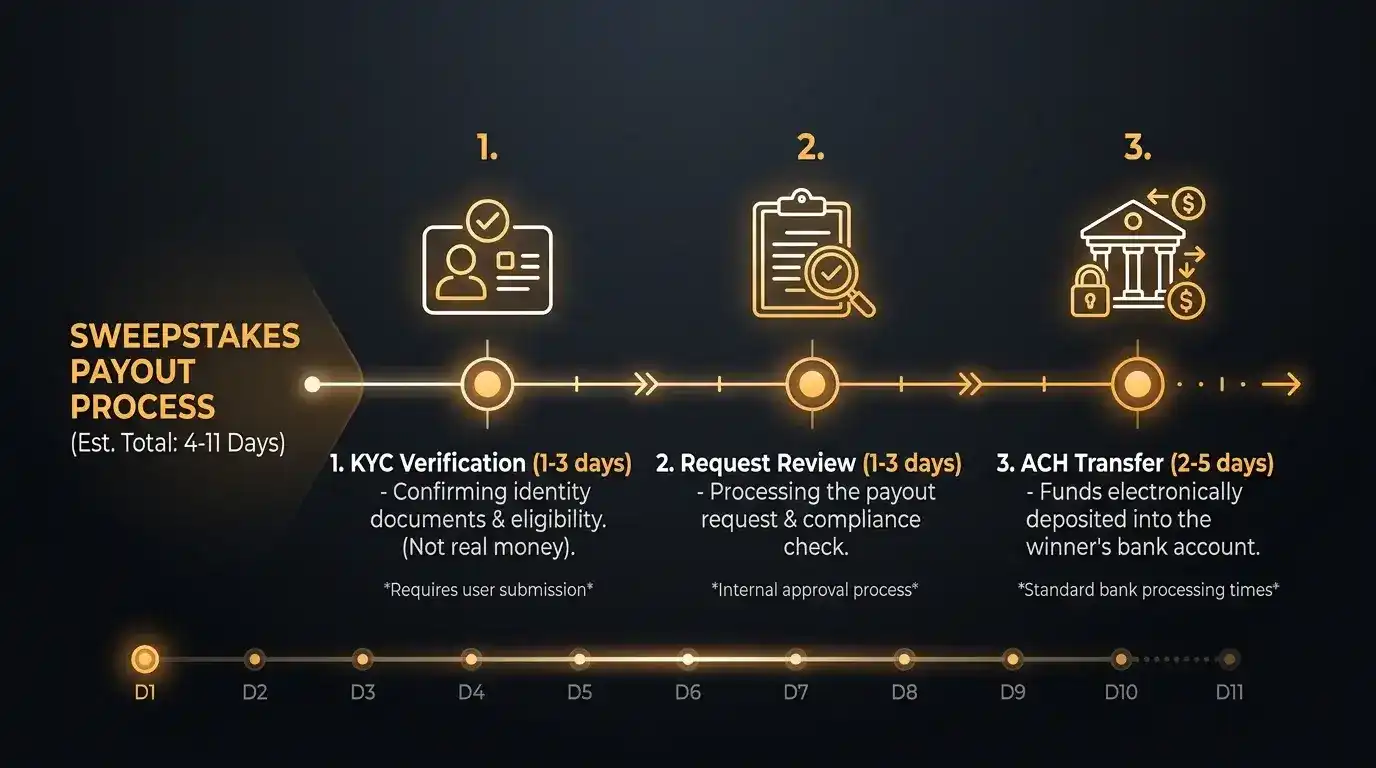
The short answer: from request submission to money available, expect three to seven business days for a smooth redemption on a well-run platform. The longer answer involves understanding the stages between “I clicked redeem” and “my bank shows a deposit.”
Stage one is verification. Your first redemption on any platform triggers KYC (Know Your Customer) verification, during which the platform confirms your identity using a government-issued ID and typically proof of address. Most established platforms have streamlined this process significantly — submitting clean, current document photos through their verification portal typically resolves in one to three business days. If you submit a blurry photo, an expired document, or a document where the name doesn’t exactly match your account name, expect delays of several additional days while customer support works through the discrepancy. Complete verification before you hit the minimum redemption threshold — don’t wait until you’re ready to cash out to realize you need to verify first.
Stage two is redemption request processing. After verification, you submit your actual redemption request through the cashier section. The platform’s payout team reviews the request — checking that your eligible balance meets the minimum, that no flags have been raised on your account, and that the requested payout method is properly configured. This processing step typically takes one to three business days for straightforward requests.
Stage three is the actual transfer. For ACH, funds move from the platform’s account to yours through the banking system, which adds two to five business days. For Skrill, this step is typically same-day after platform approval. For gift cards, digital delivery is usually within 24 hours of approval.
A player whose first redemption on a new platform goes smoothly — clean KYC documents, no account flags, ACH payout — realistically expects seven to ten days from first redemption request to money in account. Repeat redemptions on the same platform, where KYC is already cleared, drop to three to six days. This is consistent with Gaming Innovation Group’s observation that sweepstakes player lifetime value of approximately $1,000 over two years implies a sustained engagement relationship — players who redeem regularly and successfully tend to continue using platforms, while those who experience friction at the cashier stage often churn.
Red flags that suggest a payout problem: requests sitting in “processing” for more than five business days without communication from the platform; customer service tickets that go unanswered for more than 48 hours; a pattern of withdrawal requests being rejected for shifting reasons. Legitimate platforms have defined processing timelines and communicate proactively if something unusual delays a request. Platforms that consistently fail to communicate during delays are exhibiting behavior worth escalating through formal complaint channels.
Tax Obligations: IRS 1099-MISC and the $600 Threshold
Here’s the tax reality that most sweepstakes casino players don’t expect. Even though these platforms aren’t legally classified as gambling, the prizes they pay out are taxable income under US tax law. The classification that exempts them from gambling law doesn’t exempt their payouts from income tax.
The IRS requires any business that pays prizes of $600 or more in a calendar year to the same person to issue a Form 1099-MISC reporting those payments. A sweepstakes casino that processes $600 or more in redemptions for your account in 2026 is required to send you a 1099-MISC by January 31, 2027, and to file the same information with the IRS. You are required to report those prizes as ordinary income on your federal tax return.
The $600 threshold applies per platform, per calendar year. If you use five platforms and redeem $500 at each, you’ve received $2,500 in prize income but no single platform hit the $600 reporting threshold. Those amounts are still taxable income — you’re required to report all prize winnings, regardless of whether you received a 1099-MISC — but you won’t receive formal documentation from any platform in that scenario.
State tax treatment of prize income varies. Most states that have personal income taxes treat ordinary income, including prize income, as taxable. Players in states without personal income tax (Texas, Florida, Nevada, Washington, Wyoming, South Dakota, Alaska) have no state tax obligation on these prizes. For everyone else, factor state taxes into your redemption math — depending on your state and income bracket, the effective tax on large SC redemptions could reduce your take-home value meaningfully.
The smart habit for players who redeem regularly: treat a portion of every redemption as already spoken for by taxes. A rough estimate of 25% to 30% set aside for federal and state taxes combined is a reasonable buffer for most players. If you’re redeeming amounts large enough to materially affect your tax liability, consulting a tax professional about how to categorize and report sweepstakes prize income is worthwhile. For a full treatment of the IRS rules and specific reporting requirements, see  the sweepstakes casino taxes guide.
Platforms With the Fastest Payouts: 2026 Comparison
Payout speed varies meaningfully across platforms. After tracking redemption reports from players and testing processes directly, here’s how the landscape breaks down in 2026.
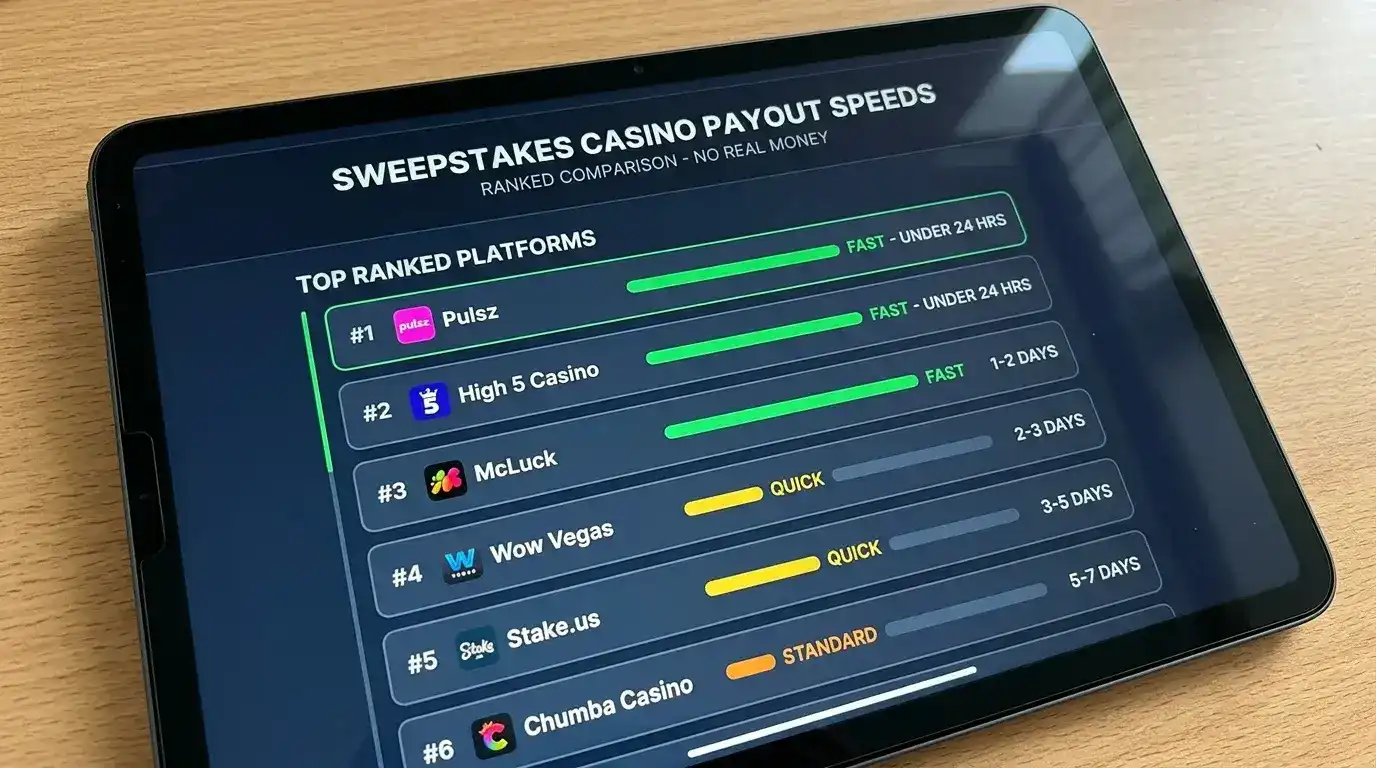
The established tier — platforms with multi-year redemption track records — generally processes requests within one to three business days and completes ACH transfers within five to seven business days total from request to account credit. VGW’s platforms (Chumba Casino, LuckyLand Slots, Global Poker) have refined their payout infrastructure over years of high-volume operation. The scale of their payout operation — over $2.83 billion in prize payments in a single fiscal year — creates process discipline that smaller platforms lack. Pulsz and McLuck have also built solid payout reputations based on consistent reporting from their player communities.
Platforms offering Skrill redemptions alongside ACH consistently receive better payout speed ratings from players who use the option. Where Skrill is available and your account is configured, same-day payout from request approval is genuinely achievable. The overall timeline advantage over ACH is three to four days for most players — meaningful if you’re redeeming frequently or in larger amounts.
Newer platforms — those that launched in 2025 or 2026 — have inconsistent payout reputations precisely because they haven’t processed enough redemptions to establish a pattern. Some newer platforms have surprised positively, processing first redemptions faster than expected as a player acquisition strategy. Others have developed early reputations for slow payouts or excessive documentation requests that suggest under-resourced operations. Gaming Innovation Group’s investor analysis noted that successful sweepstakes platforms see player lifetime values running to $1,000 over two years — and those values materialize only when players trust the redemption process enough to stay engaged long term. Fast, reliable payouts are a retention tool as much as a payout function.
My general framework for evaluating payout reliability on a new platform: look for documented redemption experiences from real players in community forums, check whether the platform has a publicly stated payout processing timeline, and start with a small test redemption at minimum threshold before building a large SC balance. A platform that processes a 50 SC redemption cleanly in the expected timeframe has demonstrated basic operational competence. Platforms that delay even minimum redemptions without explanation are flagging real process problems.
Common Redemption Problems and How to Solve Them
In nine years of reviewing these platforms, the same problems show up repeatedly. Here’s what actually goes wrong and how to handle it.
Problem: “My redemption request has been pending for over a week with no update.” This is the most common complaint. The most common cause is KYC documentation that needs re-submission — either the images were rejected for quality reasons, or there was a name mismatch between your ID and account. Check your account email first; platforms typically send a notification if documents are rejected. If you haven’t received any communication, contact customer support with your request ID and ask for a specific status update. A legitimate platform will provide one. Escalate to a supervisor if first-level support gives non-answers after 24 hours.
Problem: “I have 60 SC but the system won’t let me redeem.” Check your eligible balance versus total SC balance. Some SC may still be subject to playthrough requirements. In your account’s cashier or rewards section, there should be a breakdown showing total SC and eligible-for-redemption SC as separate figures. Wager the remaining SC through the games to meet playthrough requirements, then retry. If eligible SC is at or above the minimum and redemption is still blocked, it may be a verification issue — start with the KYC status page.
Problem: “I passed KYC weeks ago but my second redemption is taking longer than my first.” A few things can cause this. If your payout method changed between redemptions — different bank account, new Skrill account — the new method may require additional verification. Some platforms also apply enhanced scrutiny to redemptions that are significantly larger than prior requests, which triggers additional manual review. Patient communication with customer support specifying your request ID, the payout method, and the date submitted will typically clarify the specific reason.
Problem: “I was told I exceeded a redemption limit I didn’t know existed.” Some platforms cap monthly or quarterly redemption volumes. These limits aren’t always prominently disclosed. Check the platform’s terms under “redemption limits” or “withdrawal limits.” If you’ve hit a cap, the excess SC remains in your account and becomes eligible for redemption in the next period. This isn’t fraud — it’s a risk management mechanism for the operator — but it’s genuinely frustrating when you encounter it unexpectedly. Build awareness of these caps as part of understanding any platform you use seriously.

Frequently Asked Questions
The full picture is in our complete guide to US sweepstakes casinos.
The thresholds by platform: minimum redemption compared.
Created by the "SweepEdge" editorial team.