All Sweepstakes Casinos in the USA (2026): The Complete Guide
 Available in US
All Sweepstakes Casinos in the USA (2026): The Complete Guide
The first time someone explained sweepstakes casinos to me, I thought they were joking. You're telling me I can play slot-style games, build up a virtual currency balance, and then convert it into actual cash — without anyone calling it gambling? In states where real-money online casinos are completely illegal? I spent the next six months digging into the legal framework, interviewing operators, and watching this market explode from a curiosity into an industry that, by 2025, had generated $14.31 billion in purchase volume. I wasn't skeptical anymore. I was fascinated.
Nine years later, I still find this space more interesting than conventional iGaming, precisely because it exists at the intersection of consumer law, promotional sweepstakes regulation, and the relentless demand for online casino-style entertainment. There are now over 140 active sweepstakes casino platforms operating in the USA — a number that would have seemed absurd five years ago. New sites launched at a rate of more than 25 brands in 2025 alone, with 9 more going live in April 2026. At the same time, six states banned the entire category in a single year, regulators are watching closely, and one major operator paid nearly $25 million in fines. This is not a quiet corner of the internet.
This guide is the reference I wish had existed when I started. It covers how the dual-currency model actually works, which states allow it and which have banned it, how to redeem Sweeps Coins for real cash in 2026, and what the ongoing regulatory wave means for anyone using these platforms. I'll keep the opinion to where it belongs — in the analysis —
What This Guide Covers: The Numbers and Decisions That Matter
- The US sweepstakes casino market reached $14.31 billion in purchase volume in 2025 — that's not a niche, it's an industry larger than licensed online casinos were just a few years ago.
- There are 140+ active platforms, but roughly 50% of the market's revenue runs through a single operator (VGW Holdings, parent of Chumba Casino), so the landscape is less fragmented than the platform count suggests.
- As of April 2026, sweepstakes casinos cannot legally operate in 13 US states; six of those bans came in 2025 alone — the pace of regulation is accelerating.
- The 2026 redemption standard is 1 Sweeps Coin = $1 cash value, with a 50 SC minimum to withdraw; projected SC redemption volume for 2026 is $8.5-9.5 billion.
- Only 1-5% of users ever make real-money purchases — the "free-to-play" model is real, but 90% of players still describe what they're doing as gambling.
How Sweepstakes Casinos Actually Work: The Dual-Currency Model Explained
Here's what trips up most people: a sweepstakes casino is not a casino in any legal sense. It's a promotional sweepstakes platform that happens to look exactly like one. The distinction sounds like hair-splitting, but it's the entire reason these platforms can operate in 37 US states without a gambling license — and why regulators in 13 states have decided the distinction is too thin to hold.
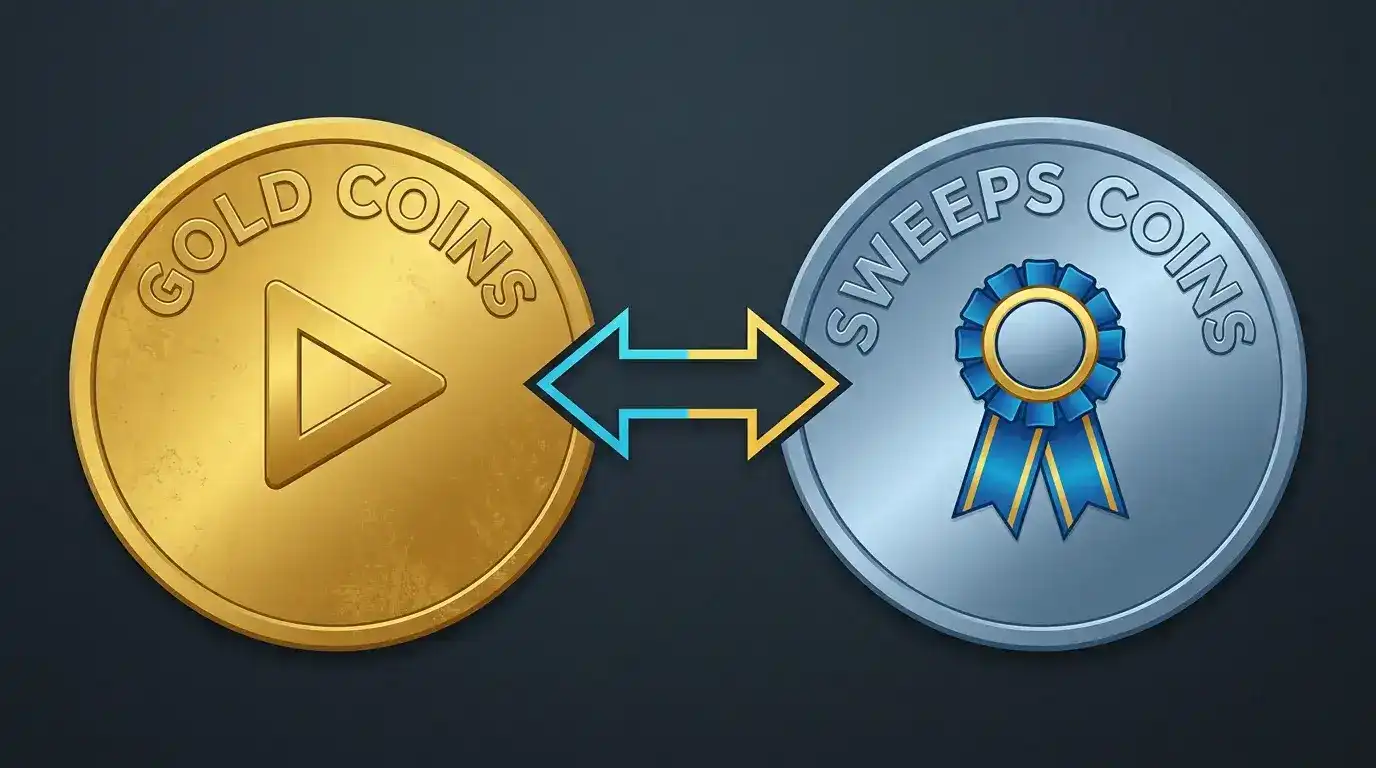
The architecture rests on two virtual currencies, and understanding the difference between them is the minimum viable knowledge for anyone using these platforms.
Gold Coins (GC) — the play-for-fun currency. You receive Gold Coins as a purchase bonus or through free daily promotions. They have no monetary value, cannot be redeemed for cash, and exist solely for entertainment play. Spending money on a sweepstakes casino platform means buying Gold Coins, not Sweeps Coins.
Sweeps Coins (SC) — the prize currency. These are the coins you can eventually redeem for real cash prizes. Crucially, you never technically "buy" Sweeps Coins — they are a promotional bonus that accompanies Gold Coin purchases, or they're obtained free through alternative entry methods. This distinction is not semantic; it's the entire legal mechanism.
No Purchase Necessary (NPN) — the legal pillar that makes the whole structure function. Under federal promotional sweepstakes law, any sweepstakes that can be entered for free is not considered gambling, regardless of how prize-like it looks. Every legitimate sweepstakes casino must provide a free method of obtaining Sweeps Coins that does not require a purchase. This is the AMOE — Alternative Method of Entry — usually a mail-in postcard request or an on-site daily login bonus.

The sequence matters: you purchase Gold Coins (legal purchase), and Sweeps Coins are awarded as a promotional bonus on top of that purchase. You can also request Sweeps Coins without any purchase via AMOE. This structure means Sweeps Coins are legally analogous to sweepstakes entries, not wagers. Players accumulate SC, play games that use SC as the stake, and if they win, they can redeem the SC balance for cash — subject to minimum thresholds and platform terms.
The math inside this model is more interesting than it first appears. According to Jon Kaplowitz, CEO of Clubs Poker, in testimony before the Maryland State Senate, only 1-5% of social casino users ever make real-money purchases. The rest play entirely on free coins. That number does two things at once: it validates the NPN framework (the free path is genuinely available), and it reveals why operators are still enormously profitable. The paying minority — the 1-5% — generates billions.
Here's how a typical session works. A player logs in and receives a daily free allocation of both GC and SC. They play a slot-style game using GC, enjoying it for free. At some point, they decide to purchase a Gold Coin package — say, $9.99 for 1,000 GC — and the platform awards a bonus of, say, 1 SC alongside it. They accumulate SC through play, through daily bonuses, through AMOE requests, and through purchase bonuses. When they've built up 50 SC or more (the standard minimum redemption threshold), they can request a cash prize redemption. Under the 2026 standard: 1 SC = $1 cash value.
What games do they play with SC? Essentially every category you'd find at a licensed online casino: slot-style games (the dominant category), video poker, table games like blackjack and roulette, and increasingly, live dealer formats. The games are functionally identical to their real-money counterparts. This is not accidental — it's a feature of the design. Platforms license the same game engines, or build their own that replicate the mechanics of licensed casino games as closely as possible.

The full mechanics of how to maximize free SC accumulation — the AMOE process, daily bonus cadences, and purchase triggers — are covered in depth in the dedicated guide on how sweepstakes casinos work. For this overview, the key point is simple: the dual-currency model is the structural foundation of the entire category. Every legal question, every bonus offer, every redemption process flows from this architecture.
The legal validity of a sweepstakes casino rests entirely on two conditions: Sweeps Coins must be obtainable without purchase (NPN compliance), and the platform must treat SC redemption as prize delivery, not gambling winnings. If either condition fails, the "sweepstakes" legal shield collapses.
The Complete List: All Active Sweepstakes Casinos in the USA
The dual-currency model described above is not proprietary — any operator can implement it. Which explains why the landscape looks the way it does: the same basic architecture running across 140+ distinct brands, all competing for the same 38 million US players. I've been tracking this space since there were perhaps 15 platforms worth mentioning, and the acceleration has been striking. More than 25 new sweepstakes brands launched in 2025 alone, with another 9 going live in April 2026. Listing all active brands individually would produce a reference table, not a useful guide — so what follows is a structured overview of market tiers and the most established operators, with a focus on what actually distinguishes them from each other.
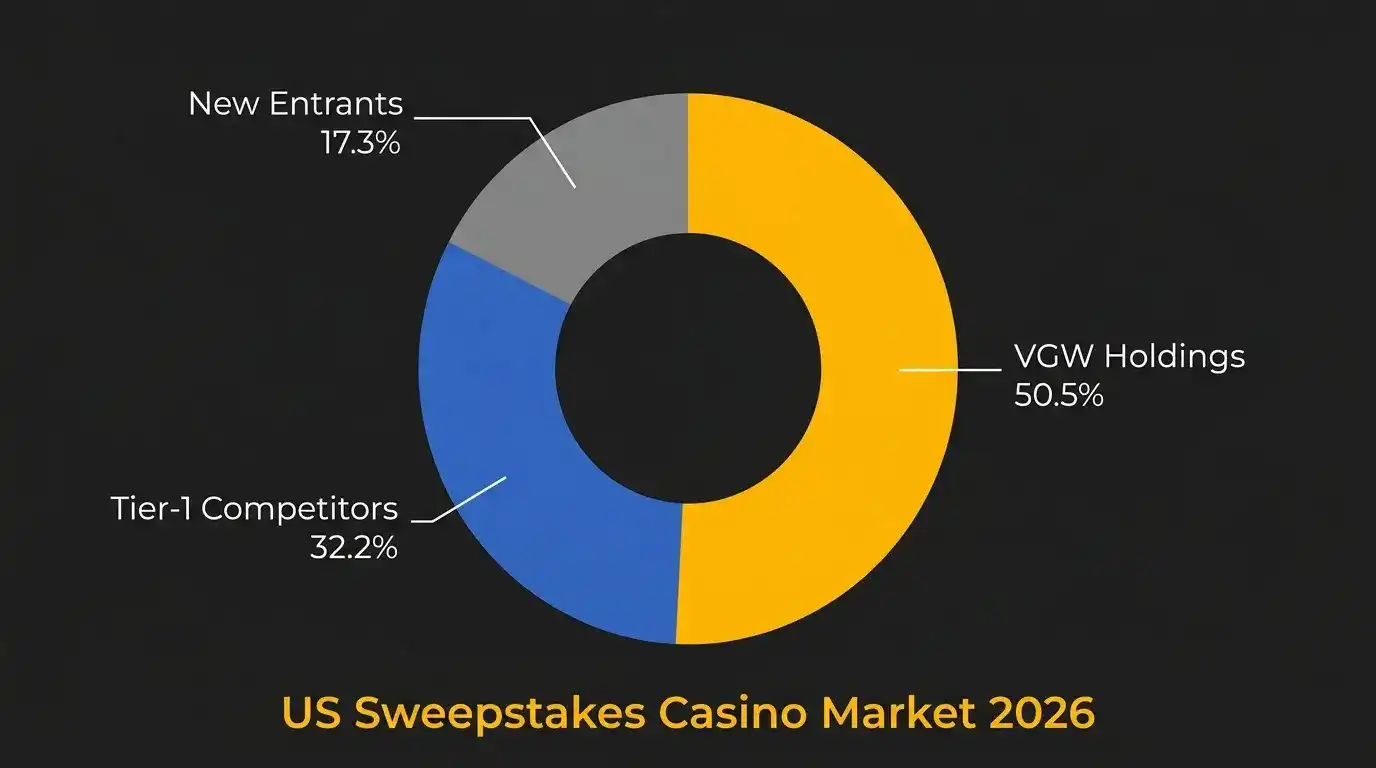
One structural fact dominates this landscape: VGW Holdings, the parent company behind Chumba Casino, LuckyLand Slots, and Global Poker, controlled over 90% of the US sweepstakes casino market just a few years ago. That share has now fallen to roughly 50% as competitors have proliferated. The market is consolidating around a tier-1 group of established operators while a long tail of newer or smaller platforms competes for the rest. This matters for anyone evaluating a platform — a well-funded operator with years of redemption history offers materially different reliability than a brand that launched in the last 12 months.
Established Tier (5+ years)
Platforms with multi-year redemption history, substantial user bases, and public operator financials. Includes Chumba Casino (VGW), LuckyLand Slots (VGW), Global Poker (VGW), Pulsz Casino, McLuck Casino, WOW Vegas, Stake.US.
Mid-Tier (2-5 years)
Platforms with meaningful user bases and documented payout histories. Growing game libraries, competitive bonus structures, typically backed by established iGaming operators entering the sweepstakes space.
New Entrants (under 2 years)
25+ brands launched in 2025; 9+ in early 2026. Higher variance on reliability and payout consistency. Typically offer aggressive welcome bonus structures to attract new accounts.
Niche Operators
Platforms focused on specific game categories (poker, bingo, specific slot themes) or demographic segments. Often sister sites sharing back-end infrastructure with larger brands.
Tier-1 Platforms: Profile Snapshots
Chumba Casino
The market-share leader. Operated by VGW Holdings (Guernsey-domiciled), with FY2025 revenue of A$5.2 billion from this property alone. Game library spans 100+ titles. Available in most US states. Redemption: 1 SC = $1, minimum 50 SC, via ACH or check.
Pulsz Casino
Consistently cited as the primary challenger to Chumba. Strong slot library with content from major providers. Active daily bonus structure. Relatively fast payout processing noted in player reports.
McLuck Casino
Mid-size platform with a reputation for above-average customer support response times and a growing game roster. Popular among players in states without major platform access.
WOW Vegas
Positioned toward a broad entertainment-focused audience. Strong visual design and mobile experience. Competitive welcome bonus on registration. Backed by established European gaming infrastructure.
Stake.US
The sweepstakes arm of the Stake brand, known internationally in crypto gambling. Carries significant brand recognition. Game variety is wide, including crash games and sports simulation formats not common at competitors.
LuckyLand Slots
VGW's slot-focused companion to Chumba. Narrower game selection (slots-only) but benefits from VGW's infrastructure and redemption reliability. Shares the same trust profile as Chumba.
How to Read the Platform Landscape in 2026
The 140+ platform count creates an impression of a highly fragmented market, but that impression is misleading in two ways. First, as noted, VGW's three brands alone represent roughly half of all revenue. Second, many of the 140+ brands are what the industry calls "sister sites" — multiple brands sharing a single back-end operator infrastructure. If you've claimed a welcome bonus at one sister site, you typically cannot claim it at another in the same network.
The platforms I watch most closely in 2026 are those navigating the post-Google-Ads landscape. Since October 28, 2025, when Google removed sweepstakes casinos from its certified social casino advertising category, the acquisition economics for every platform shifted dramatically. Operators who had relied on paid search for new-user traffic had to pivot. The platforms that managed this transition smoothly — through strong SEO, affiliate relationships, and organic retention — are the ones most likely to still be operating reliably in two years.
Legal status is not uniform across platforms. A platform may be available in 37 states in principle, but individual state rules and a given operator's own compliance decisions mean availability varies. Always verify state availability before registration — the next section covers this in detail.
Are Sweepstakes Casinos Legal in Your State?
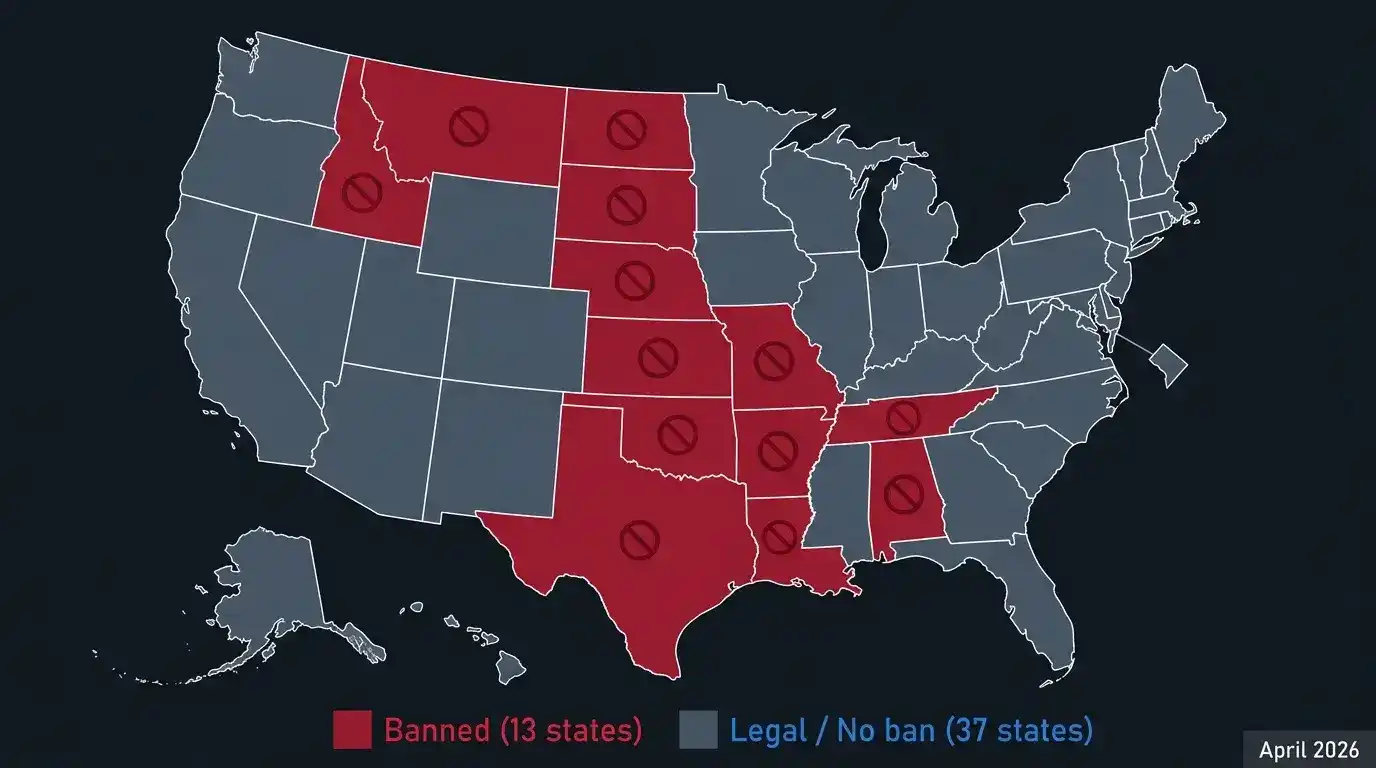
The question I get more than any other is some version of "wait, is this actually legal where I live?" The honest answer is: it depends on which state you're in, and the map has changed significantly. As of April 2026, sweepstakes casinos cannot operate legally in 13 US states. That number was lower two years ago and will almost certainly be higher two years from now.
The core legal framework is federal: US promotional sweepstakes law allows prize competitions that include a free-entry option, and that framework has never been overturned at the federal level. What's shifting is state-level action. States have the authority to regulate or ban sweepstakes gaming on their own terms, independent of federal law, and six states exercised that authority in 2025 alone.
Current legal status: Sweepstakes casinos are banned or cannot legally operate in 13 US states. The remaining 37 states are legal or have no specific prohibition — but "no prohibition" is not the same as "explicitly legal." In some states, the legal status is contested or under active review.
States With Active Bans
The confirmed ban list as of April 2026 includes: Idaho, Nevada, Washington, Michigan, Kentucky, Alabama, Mississippi, Tennessee, New York, Connecticut, Arizona, Montana, and Louisiana. This list has grown rapidly — Washington, for instance, pursued enforcement action that led to a $24.9 million settlement with one operator. Tennessee's attorney general sent cease-and-desist orders to approximately 40 sweepstakes operators on December 29, 2025, and nearly all complied within 30 days. These are not advisory opinions; they are active enforcement actions.
Nevada's inclusion surprises people at first. The state with the world's most famous gambling infrastructure bans sweepstakes casinos because its gambling laws are so comprehensive that operating any gambling-adjacent service without a Nevada Gaming Control Board license is prohibited. From Nevada's perspective, the sweepstakes mechanism doesn't change the underlying product.

The New York S5935A Situation
New York deserves its own paragraph because its approach is the most aggressive in the country. New York S5935A, passed in 2025, doesn't just ban operation — it creates a liability chain that extends to everyone facilitating the service. Fines range from $10,000 to $100,000 per violation, and responsibility can reach operators, payment processors, geolocation service providers, and marketing affiliates. This is the legal model other states are watching. The detailed breakdown of S5935A is covered in the legal states guide.
Grey Zone States
Several states fall into an ambiguous middle ground. These are jurisdictions where no explicit ban exists, but where the legal interpretation is unsettled — active litigation, pending legislation, or conflicting regulatory guidance. California is the most significant example: it's the largest single market for sweepstakes casinos, accounting for an estimated 17.3% of total US purchase volume ($2.42 billion in 2025), yet it has seen significant legislative activity and is widely expected to be a battleground state through 2026-2027. Players in grey-zone states should treat their access as potentially temporary.
A practical reality: even in legal states, specific platforms may not be available. Operators make individual compliance decisions about which states they serve, and those decisions are not always publicly documented. The only reliable way to confirm availability is the platform's own geographic restriction check, which usually occurs at registration or login.
What Happens to Your Balance in a Banned State
When a platform exits a state — either due to a ban or a compliance decision — the handling of existing player balances varies by operator. Most established platforms have honored existing balances for withdrawals during an exit window, typically 30-90 days. Newer or less capitalized platforms may handle this differently. This is one of the reasons I consistently recommend that players on platforms with significant SC balances not leave large amounts unredeemed for extended periods. The regulatory environment in 2026 makes this practical advice, not paranoia.
Assuming your state is covered, the next practical decision is evaluating what a platform actually offers when you arrive — starting with the welcome bonus, which has become the most competitive battleground in the category.
Best Sweepstakes Casino Bonuses and Welcome Offers (2026)
Bonus structures in this space were standardized and fairly predictable until mid-2025. Then the Google Ads cutoff hit, the competitive pressure for organic traffic intensified, and welcome packages started escalating in ways I hadn't seen before. April 2026 saw 9 new platforms launch — every one of them with an aggressive welcome offer designed to compete with the established tier. Understanding the structure of these offers matters more now than it did 18 months ago, because the numbers have gotten larger and the conditions haven't simplified.
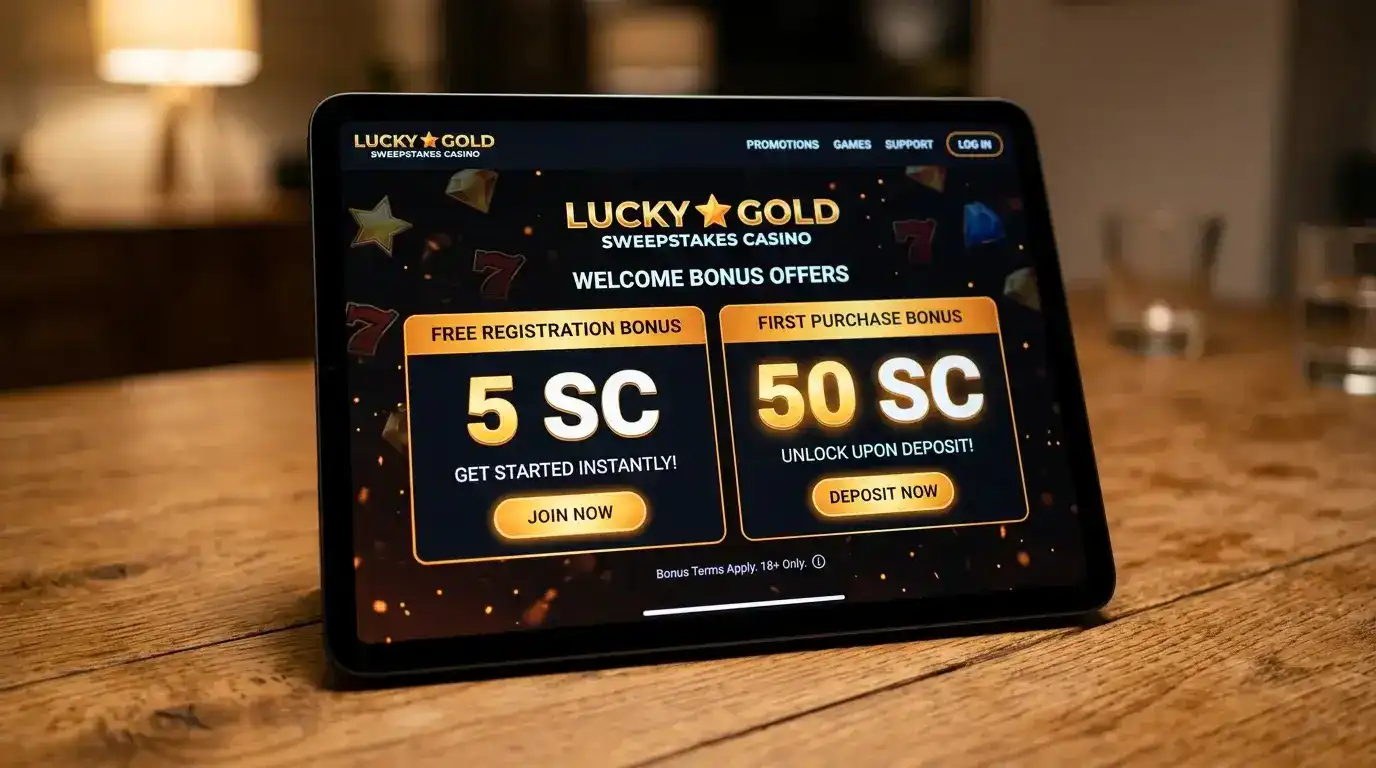
Every sweepstakes casino welcome offer combines some amount of Gold Coins with some amount of Sweeps Coins. The GC allocation is typically large (it's the marketing headline number) and the SC allocation is the part that actually matters for anyone interested in redemption. Offers at established platforms in 2026 generally follow this pattern: registration grants a small free SC allocation (commonly 2-5 SC) plus a GC package, and first purchases unlock substantially larger SC bonuses.
How Welcome Bonus Structures Work
There are three common bonus formats across the current market:
Registration-only bonuses deliver free SC on account creation, no purchase required. These are typically the smallest SC amounts (1-10 SC), but they're genuinely free and count toward the minimum redemption threshold. They exist to satisfy NPN requirements while also functioning as an onboarding hook.
Purchase-triggered bonuses are the primary vehicle for large SC allocations. A first purchase of, say, $19.99 might unlock 20-30 SC in bonus coins alongside the GC package. These are structured as "bonus" coins accompanying a GC purchase, not as something you're buying directly. The SC value in a first-purchase bonus at established platforms currently ranges from 20 SC to over 100 SC depending on purchase tier.
Ongoing promotion bonuses include daily login rewards, weekly promotions, and event-tied offers. At well-maintained platforms, these keep SC accumulation active for non-purchasing players and represent the primary source of SC for the 95%+ of users who never make a purchase.
Registration Free SC
Typically 1-10 SC, no purchase required. Available at most established platforms. Use this to understand the platform before committing money.
First Purchase SC Bonus
20-100+ SC at established platforms for first GC purchase. This is where the meaningful SC volume enters a new account.
Daily / Ongoing SC
0.5-5 SC per day at active platforms with robust daily bonus programs. Compounds significantly over time for consistent users.
What the Bonus Numbers Don't Tell You
The headline Gold Coin number in a welcome offer is marketing. The number to evaluate is the Sweeps Coin allocation and the conditions attached to it. Most platforms require SC bonuses to be "played through" — used in games before they become eligible for redemption — and the playthrough requirements vary significantly. A platform offering 100 SC with a 1x playthrough is materially better value than a platform offering 150 SC with a 10x playthrough, even though the headline SC number is lower.
Newer platforms (under 2 years old) in 2026 are competing primarily on bonus size. I've tracked welcome packages offering SC values that are two to three times what established platforms offer for equivalent purchase amounts. This is not a red flag by itself — new operators need to acquire users aggressively. But it does mean reading the terms carefully, because some of these offers come with conditions that constrain their actual usability.
The full structured comparison of 2026 welcome bonuses across platforms, including playthrough conditions and minimum deposit tiers, is covered in the dedicated sign-up bonuses guide.
Bonus Abuse and Account Risk
One practical note that doesn't get enough attention: sweepstakes platforms actively monitor for bonus abuse. Creating multiple accounts to claim welcome offers, using VPNs to access restricted states, and certain patterns of SC accumulation without GC play are all documented grounds for account restriction or forfeiture. These platforms have compliance teams and, increasingly, sophisticated fraud detection. The terms of service on this point are not decorative.
What a Sweeps Coin bundle is really worth
Headline coin counts are marketing. This calculator converts any Gold Coin package into the only number that matters: what you pay for each dollar you can actually redeem — after playthrough, the house edge, and the 50 SC redemption floor have all taken their cut.
- Headline cost per SC
- —Before any drag
- Break-even RTP
- —RTP needed to hold face value
- Break-even playthrough
- —Max × before you're underwater
- Total SC you must wager
- —To unlock redemption
- Median cash-out
- —When redemption is reached
- Modelled return per $1
- —Mean over all sessions
Offer comparison
Nothing added yet. Run an offer, then choose Add to comparison to stack it against the next one.
How this is calculated. Sweeps Coins redeem at the 2026 market standard of 1 SC = $1.00. Playthrough forces you to wager the bonus a set number of times, and every wager passes through the game's house edge, so expected surviving balance is SC − (playthrough × SC × house edge). The "chance you reach the floor" figure comes from a Monte Carlo simulation of full sessions using a slot-style payout distribution matched to your chosen RTP and volatility, played until either the redemption floor is cleared or the balance runs out.
Expected value is not a forecast. Two offers with identical expected value can have very different odds of ever producing a payout, which is exactly why the probability column exists. Figures are a model of published terms, not a promise from any operator — always read the offer's own terms. 18+. Play responsibly.
Sweepstakes Casino vs. Traditional Online Casino: Side-by-Side
The comparison people actually want to make is simple: "Is this the same as a real casino or not?" The legal answer and the experiential answer are almost opposite, which is exactly why this category generates so much debate — and why the American Gaming Association has been vocal about it. AGA vice president Tres York put it plainly: "Consumers see through the 'sweepstakes' facade and call it what it is: gambling." His organization's 2025 survey of 2,250 players found that 90% of sweepstakes casino users believe they are engaging in gambling, and 68% say winning real money is their primary motivation — identical to the 67% figure for licensed iGaming players.
That perception gap is the central tension in this industry. The legal architecture is designed to distinguish sweepstakes casinos from gambling. The player experience is designed to be as close to a real casino as possible. Both things are simultaneously true.
| Dimension | Sweepstakes Casino | Licensed Online Casino |
|---|---|---|
| Legal classification | Promotional sweepstakes | Regulated gambling |
| License requirement | None (federal level) | State gaming license required |
| State availability | ~37 states (as of April 2026) | 7 states with live iGaming (NJ, PA, MI, DE, WV, CT, RI) |
| Real-money wagering | No — Sweeps Coins are promotional | Yes — direct real-money bets |
| Cash prizes available | Yes — via SC redemption | Yes — direct cash winnings |
| Free play option | Yes — via daily free SC / AMOE | Demo mode only (no cash prizes) |
| Player protection tools | Voluntary; platform-dependent | Mandatory — deposit limits, self-exclusion |
| Regulatory oversight | None at federal level; state-level varies | State gaming authority, annual audits |
| Game RNG auditing | Not required; some platforms do voluntarily | Mandatory third-party certification |
| Tax reporting by platform | IRS 1099-MISC at $600+ redemptions | W-2G for winnings over certain thresholds |
| Dispute resolution | Platform terms only | State regulator complaints process |
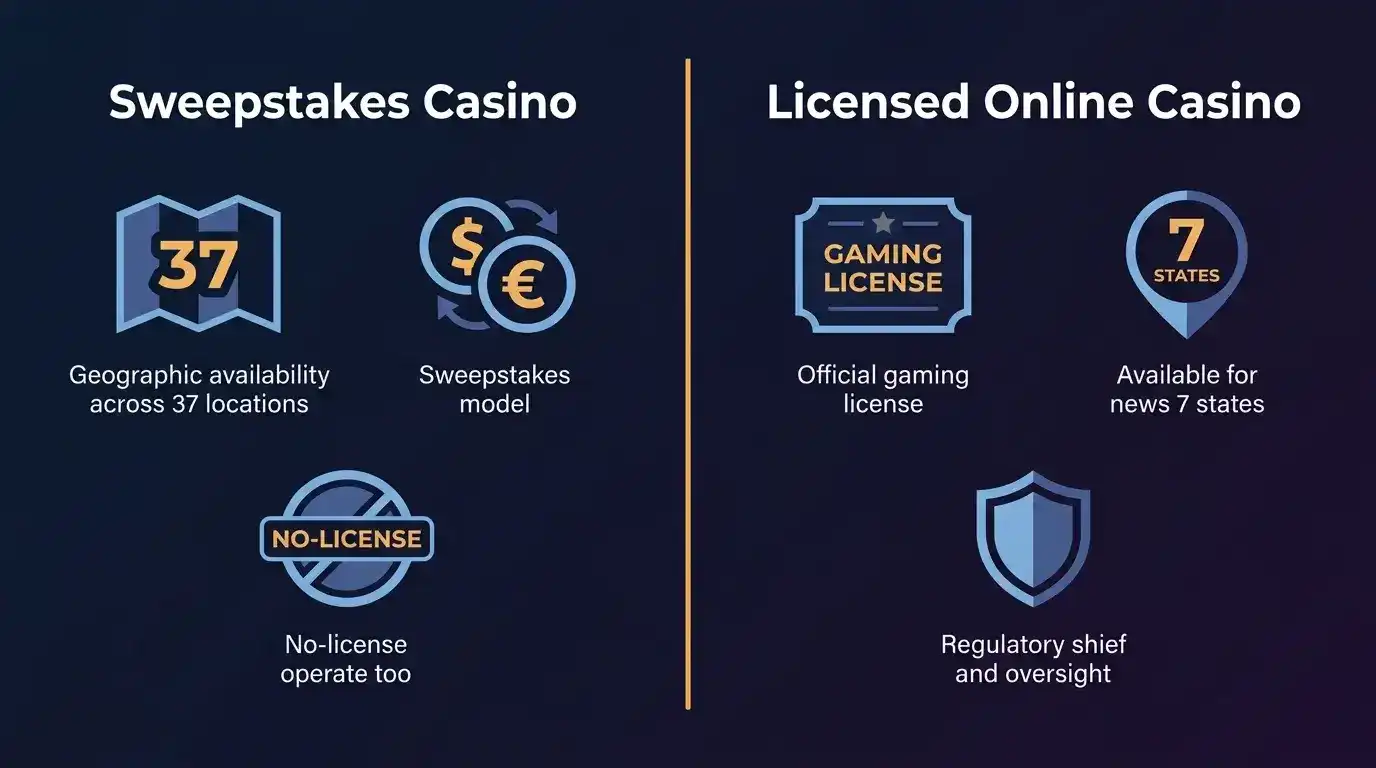
The practical difference that matters most to most people is access: licensed online casino real-money play is available in only 7 US states, while sweepstakes casinos are available in 37. For the 40+ states without licensed iGaming, sweepstakes casinos are the only legal avenue for casino-style entertainment with real cash prize potential. That's not a minor detail — it's the market rationale for the entire category's existence.
The difference that matters most to regulators and consumer advocates is the absent oversight layer. There's no mandatory deposit limit. No required self-exclusion program tied to a state registry. No standardized RNG certification. Platforms can implement these voluntarily and some do, but the minimum floor is entirely different from the licensed sector.
A deeper analysis of how the experience, economics, and risk profiles compare across these two categories — including the data on player spending patterns — is in the dedicated sweepstakes casino vs. online casino breakdown.
How to Redeem Sweeps Coins for Real Cash
Redemption is where the abstraction of "virtual currency" becomes real money in your bank account — and it's also where most first-time users hit unexpected friction. I've walked through this process dozens of times across different platforms, and the most common source of confusion is simple: players underestimate how much verification is involved before a platform will process their first withdrawal.
The 2026 Redemption Standard: Across established sweepstakes platforms, the standard conversion rate is 1 SC = $1.00 cash value. The standard minimum redemption threshold is 50 SC = $50.00. Platforms that deviate significantly from this benchmark typically do so on the minimum threshold side (some require 100 SC or more), rarely on the conversion rate. Projected total SC redemption volume for 2026 is $8.5-9.5 billion across the industry.
The Verification Requirement
Every legitimate sweepstakes casino requires identity verification (KYC — Know Your Customer) before processing a withdrawal. This is not bureaucratic friction; it's both a compliance requirement and a practical fraud prevention measure. Required documents universally include government-issued photo ID and proof of address (utility bill or bank statement dated within 90 days). Some platforms also require a selfie for biometric matching. The timeline from document submission to approval varies from 24 hours at well-staffed platforms to 5-7 business days in the worst cases I've encountered.
The rule I always give: complete KYC before you need it. Don't wait until you have a balance you want to withdraw. Submit documents early in your use of a platform, when there's no urgency and you can handle delays patiently. Platforms that reject or delay your verification are giving you important information about their reliability.

Payout Methods in 2026
The standard payout channels at established platforms are ACH bank transfer, Skrill e-wallet, and in some cases physical check. Gift card options (typically Amazon or Visa prepaid) are offered by some platforms as an alternative. ACH is the most widely available and generally the fastest for players with US bank accounts — 1-3 business days once KYC is cleared. Skrill is typically faster but requires a separate Skrill account. Checks are the slowest option (7-14 days) and are increasingly a fallback rather than a primary option at larger platforms.
Crypto redemption options, once more common, have become rarer among established US-facing platforms as compliance frameworks tightened. A few platforms still offer it, but it's not the norm in 2026.
Complete your identity verification (KYC) before building a significant SC balance, not after. Platforms are legally entitled to request verification at any time, and unverified accounts at some platforms cannot redeem at all. First-withdrawal processing takes longer than repeat withdrawals — factor in 3-7 days for the initial request even at established platforms.
For payout method comparisons, minimum thresholds across all major platforms, and how to handle common redemption problems, the complete breakdown is in the payout and redemption guide.
Regulatory Risks: The 2025-2026 Ban Wave
In February 2025, Bill Miller, president and CEO of the American Gaming Association, said something that set the tone for the year: "These illegal operations exploit consumer confusion and threaten to undermine the public trust we've spent years building." That framing — sweepstakes casinos as "illegal operations" — is contested, but it reflects the coordinated pressure campaign that produced the most consequential year of sweepstakes casino regulation in the category's history.
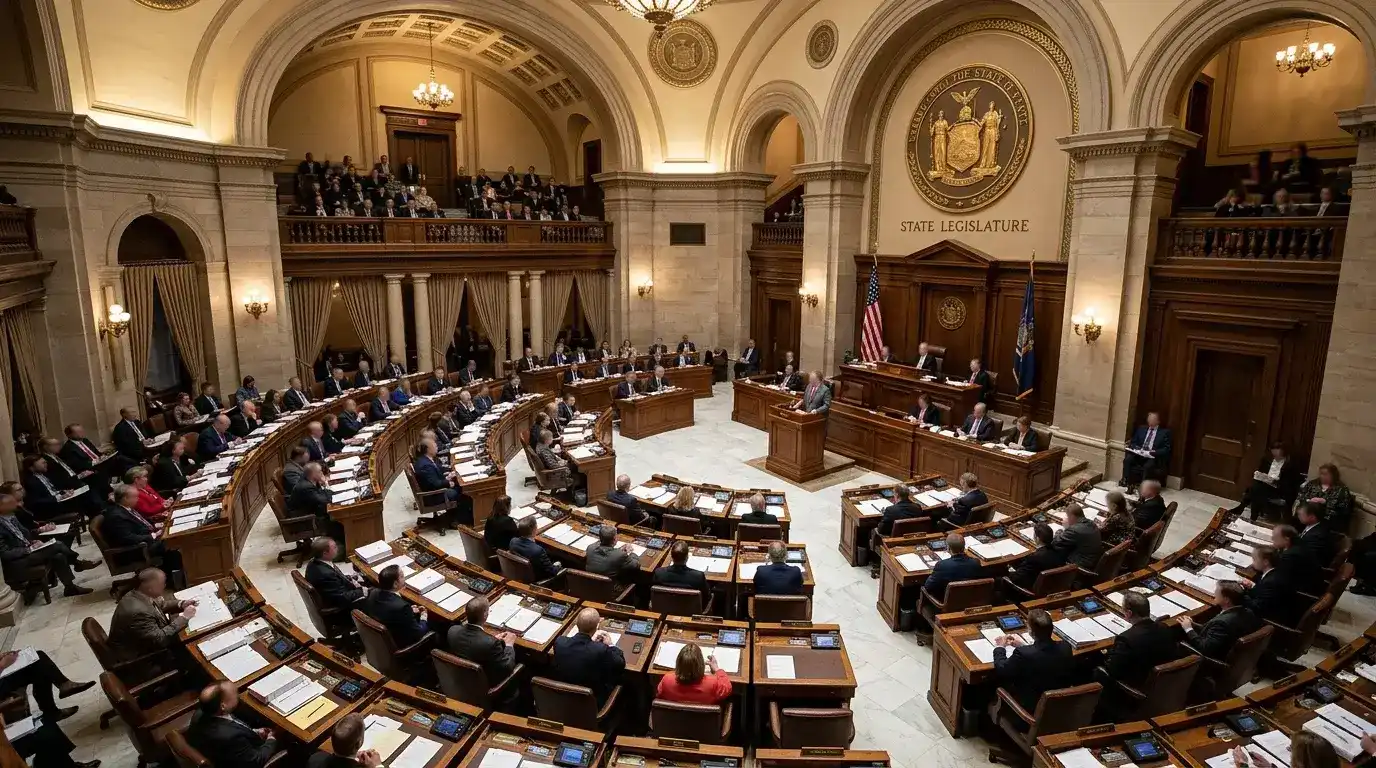
Six states passed bans in 2025. That number is the headline, but it undersells the pace of change. Six bills became law in a single calendar year after the category had operated largely unchallenged for more than a decade. The enforcement picture is even more striking: Tennessee's attorney general issued cease-and-desist orders to approximately 40 operators on December 29, 2025, and nearly all had complied within 30 days. High 5 Games settled Washington state enforcement action for $24.9 million and a separate Connecticut case for $1.5 million — the largest regulatory fines in the category's history. These are not warning shots. They are enforcement actions with real financial consequences.
Six more state legislatures considered and failed to pass similar bans in 2025. "Failed" in this context doesn't mean the issue died — it means the bills didn't reach the governor's desk in the 2025 session. Every one of those states is likely to see the legislation return in 2026. Industry observers tracking active legislative sessions in 2026 are watching Georgia, Maryland, and several other states where proposals are in committee.
Why the Ban Wave Accelerated
Three forces converged in 2024-2025 to drive the legislative wave. First, the scale became impossible to ignore: when industry revenue crossed $10 billion (passing licensed online casinos), the argument that sweepstakes gaming was a niche promotional format became untenable. Second, the AGA launched a coordinated advocacy campaign on behalf of licensed operators, who saw sweepstakes platforms as unlicensed competitors extracting revenue from the same player pool. Third, the player perception data — 90% of users believe they're gambling — gave regulators a consumer protection narrative that is more politically tractable than a pure competition argument.
The VGW Holdings annual report captured the underlying vulnerability precisely: "In the extent that operations in the US or Canada are affected or challenged by regulators, VGW's core business and ability to operate could be materially adversely affected." That's corporate disclosures language, but it accurately describes the position of every operator in this space. The legal framework is sound at the federal level. The state-level picture is deteriorating.
The regulatory risk profile of a sweepstakes platform matters as much as its bonus structure or game library when evaluating whether to build a balance there. The pre-registration checklist in the next section maps exactly what to evaluate before creating an account.
How to Choose: Pre-Registration Checklist
I built this checklist after watching too many players sign up for platforms based entirely on welcome bonus size. Bonus value is real, but it's the last thing to evaluate — not the first. The order matters: confirm the fundamentals before you assess the perks. Here's my standard evaluation sequence for any new sweepstakes casino in 2026.
More than 70% of US adults check reviews before installing a new app, and most specifically look for evidence of difficult cancellation or withdrawal processes. That instinct is correct. The signals that matter most in sweepstakes casinos map closely to what that research is pointing at: documentation of actual redemptions, clarity of terms, and evidence of responsive support when problems arise.
Before You Register: 10-Point Platform Check
- State legality: Confirm the platform is available in your state. Use the platform's own geo-check at registration — don't rely on third-party lists, which may lag actual operator decisions.
- Operator identity: Identify the corporate parent. Is it a named, documented company with publicly available information? Anonymous operator = red flag.
- Redemption history: Look for documented withdrawal confirmations in player forums and review sites. A platform with no withdrawal receipts in the wild is a platform with unknown reliability.
- NPN compliance: Can you actually obtain SC without purchasing? Test the AMOE or daily free SC process. If it requires a purchase or creates obstacles, the platform's legal compliance is in question.
- KYC timeline: How long does identity verification take? Is it required before or only at first withdrawal? Check player reports for verification rejection patterns.
- Minimum redemption threshold: What is the minimum SC to cash out? The 2026 market standard is 50 SC. Significantly higher thresholds (200 SC+) increase the time investment before you can evaluate the platform's actual payout reliability.
- Payout methods: Does the platform support ACH or another method you can actually use? Platforms offering only checks or gift cards limit your flexibility.
- Terms of service: Read the bonus terms. Look specifically for playthrough requirements, geographic restrictions, and account verification language. Vague or overly restrictive terms are a predictive signal.
- Customer support accessibility: Test the support channel before you need it. Send a non-urgent question. Response time and quality are predictive of how they'll handle an actual dispute.
- Launch date and operator track record: How long has the platform been operating? Platforms under 12 months have no meaningful redemption history to evaluate. If you're using a new platform for its welcome bonus, cap your purchase exposure accordingly.
The sweepstakes casino concept traces back to promotional law frameworks developed in the mid-20th century for consumer packaged goods sweepstakes. The same legal structure that governs "no purchase necessary" entry on a cereal box underlies a platform processing $8+ billion in annual redemptions. The law didn't change — the product built on top of it became unrecognizable.

Frequently Asked Questions
What is a sweepstakes casino and how does it work?
A sweepstakes casino is a platform that offers casino-style games (slots, table games, video poker) using two virtual currencies: Gold Coins, which have no monetary value and are used for entertainment play, and Sweeps Coins, which can be redeemed for real cash prizes. The legal structure rests on federal promotional sweepstakes law: because Sweeps Coins can be obtained without purchase (via free daily bonuses or mail-in alternative entry), the platform does not meet the legal definition of gambling. Players accumulate Sweeps Coins through gameplay, and once they reach the minimum threshold (typically 50 SC = $50), they can request a cash redemption via ACH transfer or other supported methods. The conversion rate at established platforms is 1 SC = $1.00.
Which US states have banned sweepstakes casinos in 2026?
As of April 2026, sweepstakes casinos cannot legally operate in 13 US states: Idaho, Nevada, Washington, Michigan, Kentucky, Alabama, Mississippi, Tennessee, New York, Connecticut, Arizona, Montana, and Louisiana. This count has increased significantly — six of these bans were enacted in 2025 alone. Additional states are reviewing legislation in 2026. If you're in one of these states and attempt to access a compliant sweepstakes platform, you'll typically be blocked by geolocation technology at registration. State law applies based on your physical location, not your billing address.
Can you win real money at a sweepstakes casino?
Yes — this is the defining feature that distinguishes sweepstakes casinos from purely social casino apps. When you accumulate Sweeps Coins through play or free entry methods and redeem them for prizes, the cash payment is real. The 2026 standard rate is 1 SC = $1.00, with a minimum of 50 SC to request a withdrawal. Established platforms with documented redemption histories pay out routinely. The distinction is that you're not "winning" in the traditional gambling sense — you're receiving a prize through a sweepstakes mechanism. The IRS, notably, treats this prize income as taxable: platforms are required to issue a 1099-MISC for annual redemptions totaling $600 or more.
How is a sweepstakes casino different from a real-money online
casino?
The structural difference is legal classification: licensed online casinos are gambling operations regulated by state gaming authorities, available in only 7 US states (New Jersey, Pennsylvania, Michigan, Delaware, West Virginia, Connecticut, Rhode Island). Sweepstakes casinos are classified as promotional sweepstakes businesses, not gambling operations, and operate in approximately 37 states without state gaming licenses. In practice, the game interfaces are visually and mechanically similar. The key practical differences: sweepstakes casinos have no mandatory deposit limits or state-linked self-exclusion programs, their RNG outcomes are not required to be audited by state-approved labs, and player dispute resolution goes only to the platform itself rather than a state regulator. The broader analysis of how these two models compare on economics, player protection, and risk profile is covered in detail in the dedicated comparison guide.
What are the best sweepstakes casinos in the USA right now?
The established tier of sweepstakes casinos with multi-year redemption histories includes Chumba Casino (largest by revenue, operated by VGW Holdings), LuckyLand Slots (VGW's slot-focused companion platform), Pulsz Casino, McLuck Casino, WOW Vegas, and Stake.US. Each has a documented track record of processing withdrawals and handling player accounts consistently. The most appropriate platform for a given player depends on game preferences, state availability, and payout method compatibility. As of 2026, the market has over 140 active brands, but the tier-1 group above represents the most reliably documented payout history. New platforms launching in 2025-2026 have aggressive welcome offers but limited track records.
Are sweepstakes casino prize redemptions treated as taxable
income by the IRS?
Yes. Cash prizes received through sweepstakes casino redemptions are taxable income under IRS rules. Platforms are required to report individual annual prize redemptions of $600 or more on Form 1099-MISC, which is also sent to the IRS. You are responsible for reporting this income on your federal tax return regardless of whether you receive a 1099. There is no automatic withholding by the platform — unlike some lottery or casino winnings, sweepstakes prizes are typically paid in full with the tax obligation left to the recipient. Redemptions below $600 are still taxable income; they simply may not trigger a 1099 from the platform. If you're redeeming meaningful SC amounts across multiple platforms, tracking your annual prize income is a tax compliance responsibility.
How can I verify that a sweepstakes casino is legitimate and
safe?
Five signals that distinguish legitimate sweepstakes platforms from problematic ones: (1) Identifiable corporate parent — the operating company is named, registered, and findable through basic research. (2) Documented NPN compliance — free Sweeps Coins are genuinely available without purchase, and the alternative entry method actually works. (3) Player-verified redemptions — independent player reports in forums and review platforms confirm that withdrawals are processed as described. (4) Clear KYC process — identity verification requirements are documented upfront, not sprung after you've built a balance. (5) Accessible customer support — the platform responds to pre-sale inquiries in a reasonable timeframe. Platforms that fail on any of these five points present meaningful account risk. A platform with aggressive bonuses but no identifiable operator, no documented redemptions, or non-functional support should be avoided regardless of its welcome offer.
Created by the "SweepEdge" editorial team.