
How Sweepstakes Casinos Work: The Dual-Currency System Fully Explained
 Available in US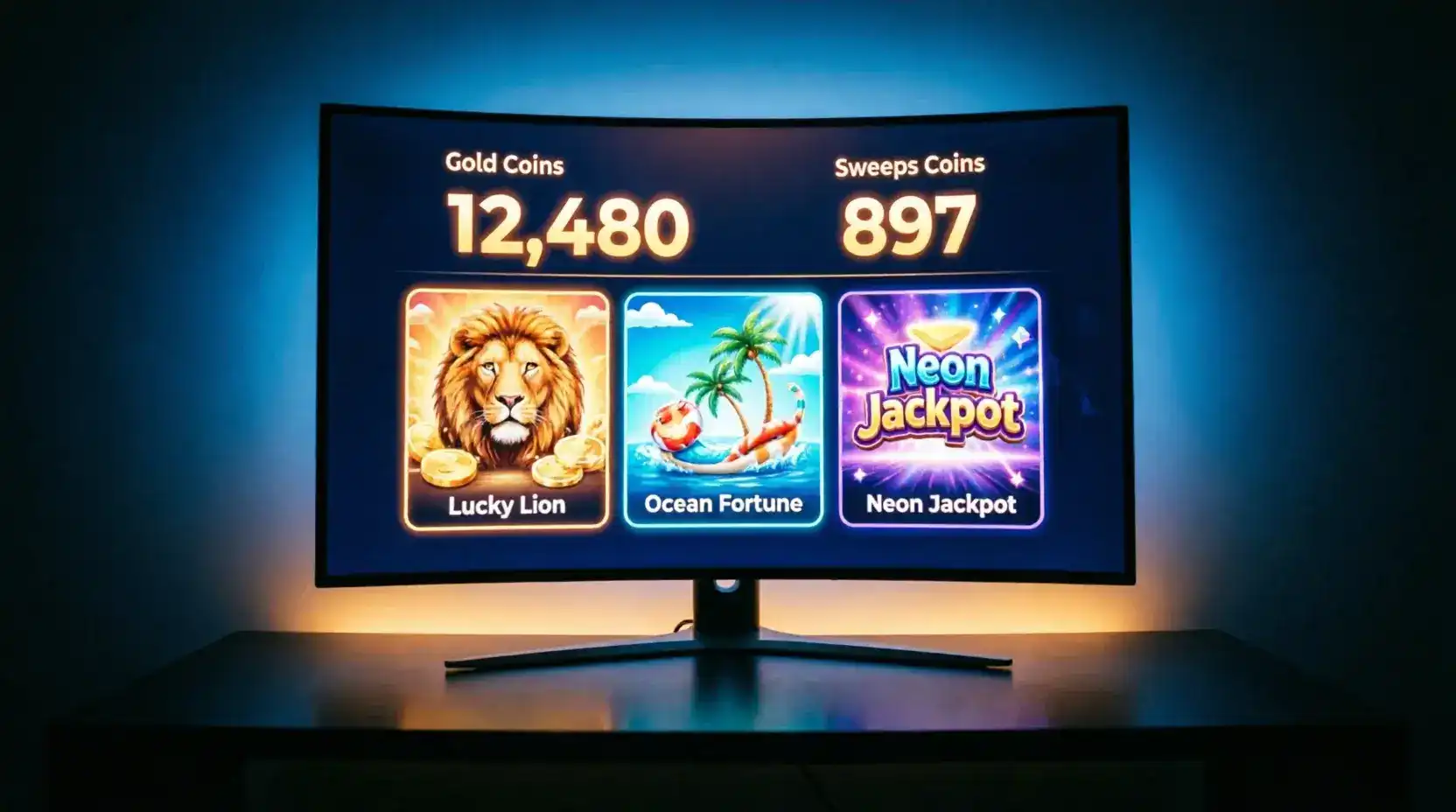
The first time someone explained sweepstakes casinos to me, I thought they were pulling my leg. You play the same slot games you’d find at any real-money casino. You can convert your winnings into cash and withdraw via ACH to your bank account. And the whole operation is legal in 37 states without a gambling license. Nine years of analyzing these platforms and I still find the architecture genuinely clever. The trick isn’t a loophole — it’s a legal framework that’s been standing since before most of today’s players were born. Understanding how it works is the difference between using these platforms intelligently and stumbling around confused about why your coins don’t all spend the same way.
What makes sweepstakes casinos tick is a two-currency design that separates entertainment from prize eligibility. Every platform runs two types of virtual coins simultaneously, and most confusion players experience comes from not knowing exactly what each one does. Let me walk through the whole system, start to finish.
The numbers tell part of the story: only 1 to 5% of users at social casino platforms ever make a real purchase. The rest play entirely on free coins. That statistic from Clubs Poker CEO Jon Kaplowitz — delivered during Maryland Senate testimony in 2025 — says something important about how these platforms actually function for most of their users. The prize redemption economy is real, but the free-play pathway is the backbone of the model.
Gold Coins vs. Sweeps Coins: What Each Currency Does
Think of it this way: a sweepstakes casino is running two games simultaneously on the same platform. One game is free entertainment with no stakes. The other is a promotional sweepstakes where prizes can be redeemed for cash. Gold Coins belong to the first game; Sweeps Coins belong to the second.
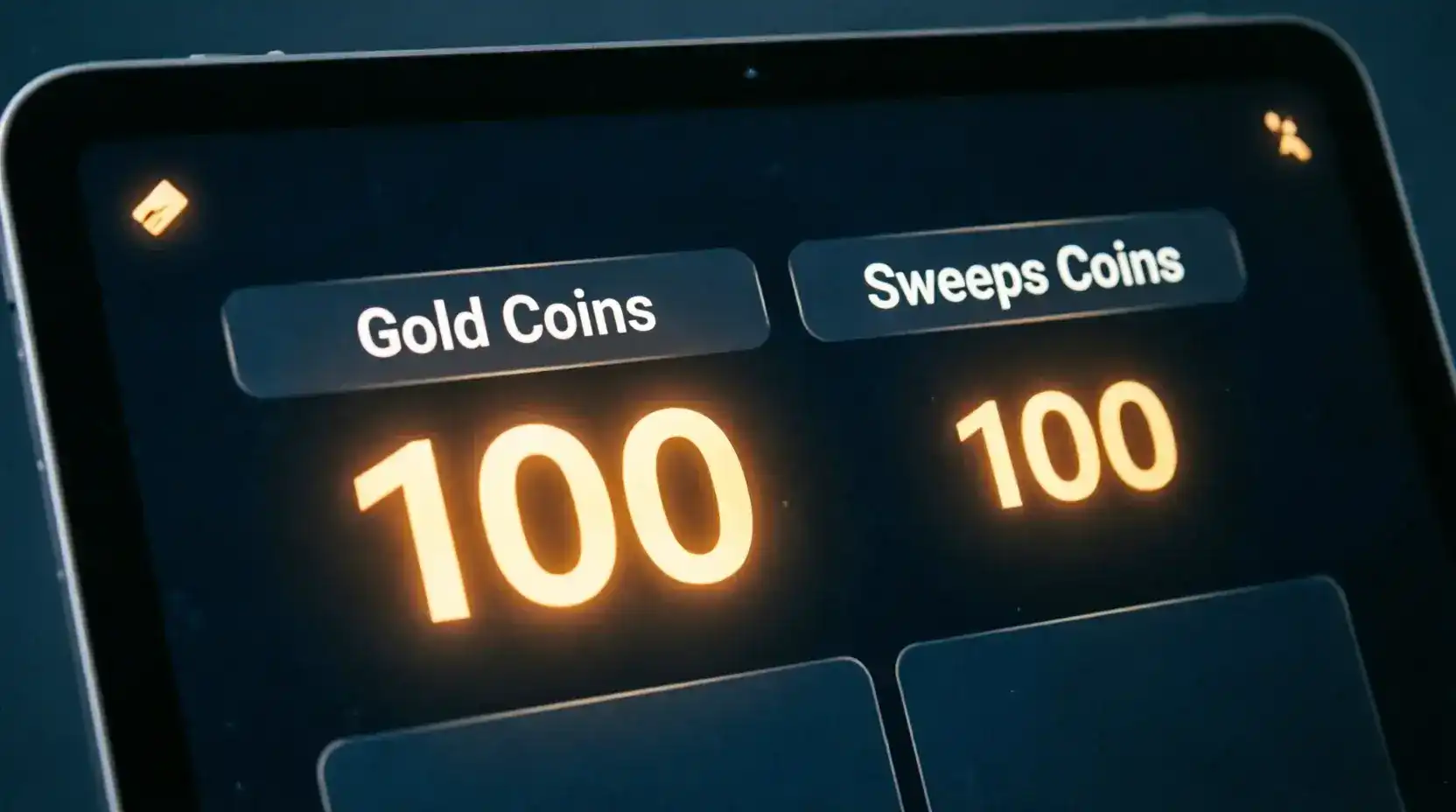
Gold Coins (GC) are the entertainment currency. They have no monetary value, cannot be redeemed for prizes, and exist purely to let you play games. You get them in large quantities — often tens of thousands at a time — and spend them freely. When you run out, platforms will either give you more for free through daily login bonuses or let you buy packages. Buying a Gold Coin package is the commercial transaction that drives operator revenue, but critically, that purchase never directly buys Sweeps Coins. You’re always paying for Gold Coins; any Sweeps Coins that come with the package are bundled in as a promotional bonus.
Sweeps Coins (SC) are the prize currency. Each one carries a defined cash value — the 2026 industry standard is 1 SC = $1 USD. These are the coins that matter if you’re interested in redeeming winnings. You can accumulate them through free channels without ever spending money, or they arrive as a bonus alongside Gold Coin purchases. When you play games using Sweeps Coins, your wins and losses affect your SC balance. Accumulate 50 SC or more (the standard minimum threshold at most platforms), and you can submit a redemption request and receive that value in real currency.
The player experience feels identical regardless of which currency you’re using. The same slot spins, the same reel animations, the same RTP percentages. The only visible difference is which coin counter is ticking in your balance display. Platforms design it this way deliberately — the unified gameplay experience is part of what keeps users engaged across both currency modes.
One thing that trips up new players: Sweeps Coins winnings typically carry a playthrough requirement before redemption is available. A platform might require you to wager your initial SC allocation at least once — or sometimes two to four times — before you can submit a cash-out. This is the sweepstakes equivalent of a wagering requirement, and it varies significantly between platforms. A player who receives 2 SC on sign-up and tries to immediately cash out $2 is going to hit a wall. Reading the specific playthrough terms for any SC balance is the single most important habit I push on anyone new to this space.
From a revenue standpoint, the average sweepstakes casino player generates $10 to $50 per month in ARPU (average revenue per user), though this varies sharply by engagement level. Players who primarily use free coins contribute essentially nothing in direct revenue — their value is engagement data and potential conversion. Active Gold Coin buyers drive the actual economics. Across the lifetime of an active buying player, the industry average runs to roughly $1,000 in total value over two years, according to Gaming Innovation Group’s investor analysis. That number is what operators are optimizing for when they design their free-coin distribution strategies.
The “No Purchase Necessary” Rule: How Operators Stay Legal
Here’s the clause that makes the whole system work. Federal promotional sweepstakes law requires that any sweepstakes offering prizes must include a “No Purchase Necessary” pathway — meaning anyone must be able to enter and win without spending money. Sweepstakes casinos are structured as promotional sweepstakes under this same legal framework, which is why they can operate without gambling licenses in most states.
The NPN rule isn’t a formality buried in fine print. It’s the structural foundation that keeps these platforms in a different legal category from regulated gambling. For the model to hold up legally, operators must genuinely provide free Sweeps Coins through channels that don’t require a purchase, and that free pathway must be functionally accessible — not an obstacle course designed to discourage use.
In practice, the NPN rule is satisfied through several mechanisms. Most platforms offer free Sweeps Coins as part of the registration process, no purchase required. Daily login bonuses distribute small quantities of both Gold Coins and Sweeps Coins at no cost. Time-limited promotional events award Sweeps Coins to active players. And then there’s the mail-in method — the AMOE, or Alternative Method of Entry — which we’ll cover in a moment.
What does it look like when this is challenged legally? A few enforcement actions have tested it. The central question regulators ask is whether the free pathway is genuinely accessible or whether it’s structured to be so cumbersome that it functions as no pathway at all. Platforms that bury the free entry option in hard-to-find corners of their sites, or that cap AMOE requests so severely that it’s effectively not usable, are on shakier legal ground. The ones that have remained robust have maintained clear, prominent free-entry options that actually work.
Jon Kaplowitz, testifying before the Maryland Senate in 2025 about exactly this framework, noted that only 1 to 5% of social casino users ever make real-money purchases. If the overwhelming majority of users never pay, that’s genuine evidence the free pathway functions — you can’t meaningfully argue a game is de facto pay-to-play when 95 to 99% of players never pay. That testimony, while delivered in a politically charged regulatory context, accurately describes the behavior pattern across the industry.

There’s an important distinction between the federal NPN framework — which is what keeps sweepstakes casinos broadly legal — and state-level gambling laws, which operate independently. A few states have determined that sweepstakes casinos fall under their gambling statutes regardless of the federal promotional framework. The NPN rule doesn’t override state law; it creates a federal-level legal basis that most states have not challenged. States that have moved to ban sweepstakes casinos have done so by creating specific state legislation, not by arguing that the NPN framework is invalid.
How You Get Free Sweeps Coins Without Spending a Dollar
I’ve tested the free-coin mechanics at over two dozen platforms at this point, and the range of generosity is genuinely wide. Some operators are serious about keeping non-paying players engaged; others make free Sweeps Coins so scarce that the “free” angle feels like a marketing fiction. Here’s what actually exists and how to use it.
Registration bonuses are the most common and typically the most substantial single free SC allocation you’ll receive. Most established platforms give between 2 SC and 10 SC just for creating a verified account — no purchase required, no promo code needed. This amount is modest in absolute terms, but it’s genuinely free and subject to standard playthrough terms before redemption.
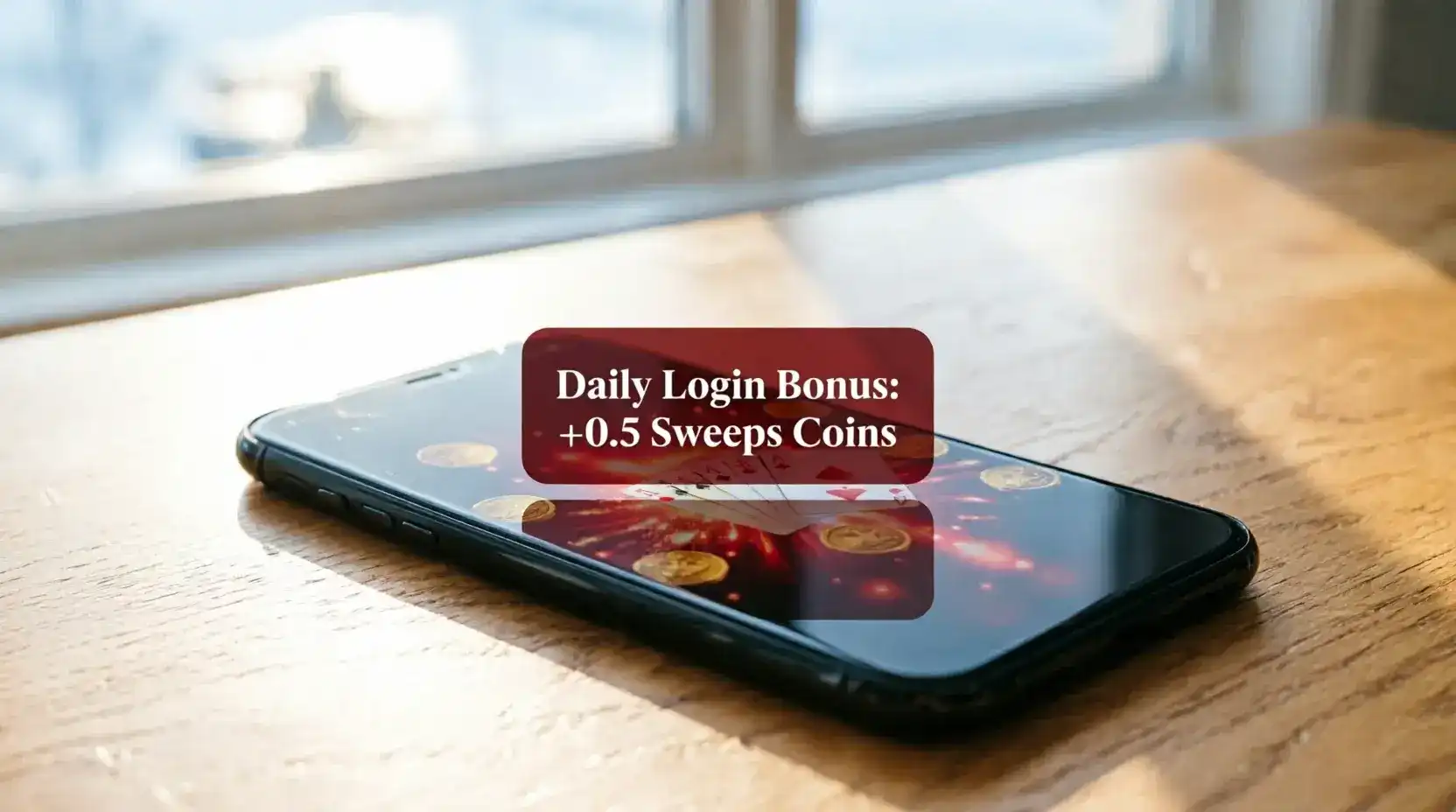
Daily login bonuses keep the free flow going. Most platforms automatically credit your account with a small SC allocation — typically 0.3 to 1 SC — every day you log in. It’s not enough to build significant balances quickly, but it compounds over time. A player logging in every day for a month might accumulate 15 to 30 SC through login bonuses alone. Given that most platforms require 50 SC to redeem, this is a legitimate if slow path to the minimum threshold.
Promotional events accelerate free coin accumulation significantly. Time-limited events — “happy hour” multipliers, weekend drops, seasonal promotions — can award SC in quantities that dwarf daily login credits. The catch is that these require active monitoring. Players who check in daily and participate in events consistently tend to accumulate free SC at roughly three to five times the rate of pure login-only players.
Email promotions and social media channels are additional free SC sources at many platforms. Some operators run weekly sweepstakes through their official social media accounts, awarding SC to randomly selected participants. These are genuine free entries, not marketing illusions, and they’re part of the same NPN legal framework as the main platform. Following the official social accounts of platforms you use is worth doing if you’re optimizing for free coin accumulation.
Friend referrals, when available, can be another free SC source. The structure varies — some platforms award SC when a friend registers, others when they make their first Gold Coin purchase. The latter isn’t truly free in the chain, but the referring player receives SC without spending anything themselves.
The difference between platforms on free SC generosity is meaningful. Operators that provide 5 to 10 SC on registration, daily login allocations, and regular promotional events are structurally set up to let non-paying players reach redemption minimums eventually. Platforms that provide under 1 SC on sign-up with minimal daily credits are effectively treating the “free” marketing as a formality. I flag this in reviews because it affects the real experience of players who don’t intend to buy Gold Coins.
The AMOE Method: Overview and Free Entry Option
The Alternative Method of Entry — AMOE — is the mechanism that has traditionally been the most legally bulletproof part of the NPN framework. It’s also the most underused, because it requires actual physical effort. The premise: any player can mail a handwritten request to a platform’s registered sweepstakes address and receive free Sweeps Coins in return.
The request format is standardized across the industry: a 3″ x 5″ notecard with your full name, address, email, date of birth, and a request for Sweeps Coins. Envelope to the platform’s sweepstakes address. The number of coins per request, the monthly cap, and the processing time vary by operator, but the mechanism itself is universal. Most platforms award the same small SC allocation via AMOE that they’d give through their on-platform free entry option — typically 1 to 2 SC per request, with monthly limits of one or two requests.
AMOE isn’t a fast path to significant SC accumulation. But it’s the one free entry mechanism that exists entirely outside the digital platform — no login required, no marketing funnel, just mail. For players curious about the legal mechanics of how these platforms actually satisfy NPN requirements, AMOE is the clearest demonstration. A complete step-by-step guide with current addresses by platform exists for anyone who wants to pursue it.

From Coins to Cash: The Redemption Mechanics in 2026
When I started covering this space, redemption processes were inconsistent enough that player complaints about delayed or failed payouts were common. The industry has standardized considerably since then. In 2026, the established redemption framework follows a defined pattern that most major platforms have converged on.
The 2026 standard: 1 SC = $1 USD. This exchange rate is stable across the major platforms; the era of platforms using opaque conversion rates to obscure the real value of SC is largely behind us, at least among the established operators. When you have 100 SC in your balance, that represents $100 in redemption value.
The minimum redemption threshold at most platforms is 50 SC, which equals $50 in cash value. This threshold exists both as a practical limit for payment processing and as a de facto floor on what counts as a “real” player balance. Some platforms have set the minimum higher — I’ve seen thresholds up to 100 SC at a handful of operators — but 50 SC has become the de facto industry standard. According to projections from EKG and operator data analyzed by rg.org, the SC redemption volume for 2026 is expected to run between $8.5 and $9.5 billion, a figure that dwarfs the early years of this industry.
Before redemption is available, your SC balance typically must meet playthrough requirements. Most platforms require you to wager the SC allocation you received at least once before it becomes eligible for cash-out. This is stated differently by different operators — “play-through requirement,” “wagering requirement,” “redemption eligibility” — but the underlying mechanic is the same: you need to run the coins through the games before you can pull them out. Winnings generated during playthrough are eligible for redemption immediately.
The actual redemption process starts in your account’s rewards or cashier section. You select the amount to redeem, choose a payout method, and submit the request. Identity verification is required before your first redemption — this is the KYC step where you’ll need to provide a government ID and sometimes additional documentation. The verification process has improved substantially at most platforms; what used to take weeks now typically resolves in one to three business days if you submit clean, readable documents.
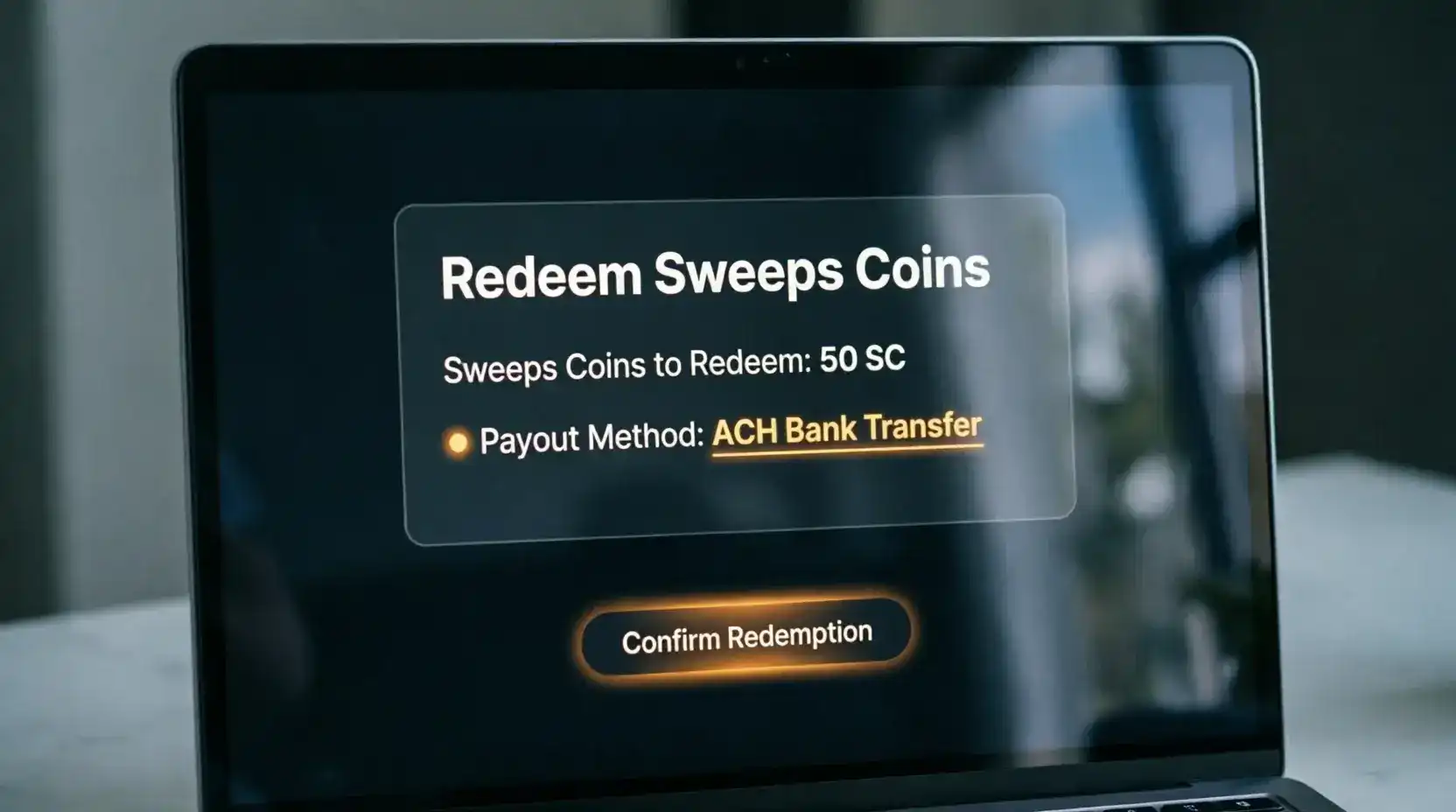
Payment methods available at most major platforms in 2026 include ACH bank transfer (the most common), Skrill (the e-wallet option favored by players who want faster processing), physical check by mail, and gift cards from major retailers. Crypto redemptions are available at a small number of platforms — primarily those with roots in the crypto-native gaming space. ACH transfers typically settle in two to five business days after approval; Skrill can process same-day once the platform approves the request.
The tax picture matters here. If your total annual redemptions from a single platform reach $600 or more, that platform is required to issue you an IRS Form 1099-MISC. The winnings are treated as ordinary income. This catches some players off guard — they don’t think of sweepstakes casino prizes as taxable because the platforms are legally “not gambling,” but IRS treatment of prize income doesn’t follow the same classification as gambling law. If you’re redeeming meaningful amounts, set aside a portion for taxes from the start.
For a full breakdown of payout speeds by platform, payment method comparisons, and KYC requirements, the detailed coverage is at the sweepstakes casino payouts guide.
Why Federal Law Allows This: The Promotional Sweepstakes Framework
The legal architecture of sweepstakes casinos rests on federal promotional sweepstakes law, which has governed contests and prize promotions since the 1950s. Under this framework, a promotion that awards prizes based on chance is legal provided it meets three criteria: no purchase is necessary to enter, all entrants have an equal chance of winning, and prizes are awarded by random selection. Sweepstakes casinos are structured to satisfy all three.
The “equal chance” element is particularly interesting in the casino context. When you play a slot game using Sweeps Coins, the outcome is determined by a certified random number generator — the same RNG that governs real-money slot outcomes. Your odds are the same whether you funded your SC through a Gold Coin purchase or through a free daily login bonus. The game doesn’t know or care where your SC came from. This is the “equal chance” element, and it’s what distinguishes the model from schemes where paying players get better odds than free players.
Federal prohibition on illegal gambling (18 U.S.C. § 1955) requires three elements for an activity to qualify as gambling: consideration (payment), chance (random outcome), and prize (valuable reward). Sweepstakes casinos break the chain at “consideration” by ensuring Sweeps Coins are available without purchase. Since SC can be obtained free, the element of mandatory consideration is absent — and without all three elements, the federal definition of gambling doesn’t apply.
As of April 2026, this framework holds in 37 states. The 13 states that have banned sweepstakes casinos have done so through state-level legislation that either redefines the consideration element, takes a different view of the promotional exemption, or explicitly excludes sweepstakes gaming from that state’s version of the promotional framework. Those bans operate as state law; they don’t invalidate the federal framework in states that haven’t moved to ban.
The practical result of this legal architecture is that sweepstakes casino operators don’t hold gambling licenses, aren’t subject to gambling regulatory bodies, don’t contribute to state gambling tax revenue, and aren’t bound by the responsible gambling requirements that licensed operators must follow. This is simultaneously what makes them accessible in states that don’t permit online gambling and what has driven the legislative backlash in states that have moved to ban them. The federal promotional framework was designed for magazine contests and cereal-box sweepstakes — applying it to a persistent, app-based gaming platform that generates billions in annual revenue was an evolution the lawmakers of the 1950s never anticipated.
The regulatory trajectory is toward more scrutiny, not less. In 2025 alone, six states passed laws restricting or banning sweepstakes casinos, and six others failed to pass similar legislation, meaning the legislative pressure is real and ongoing. Operators that have survived and grown in this environment have done so by maintaining genuine NPN accessibility and clean redemption processes — not by exploiting regulatory gaps carelessly.

The question of whether sweepstakes casinos will eventually face federal-level regulation is genuinely open. For now, the promotional sweepstakes framework holds, and the model operates legally where state law hasn’t overridden it. Understanding that the legality is structural — built into the architecture of how Gold Coins and Sweeps Coins are separated — is what separates informed players from those who assume these platforms operate in some kind of permanent legal gray zone that could collapse overnight.
Frequently Asked Questions
The full picture is in our complete guide to US sweepstakes casinos.
The free-entry route in detail: the AMOE guide.
Published by the SweepEdge team.