
Sweepstakes Casino vs. Online Casino: What's Actually Different in 2026
 Available in US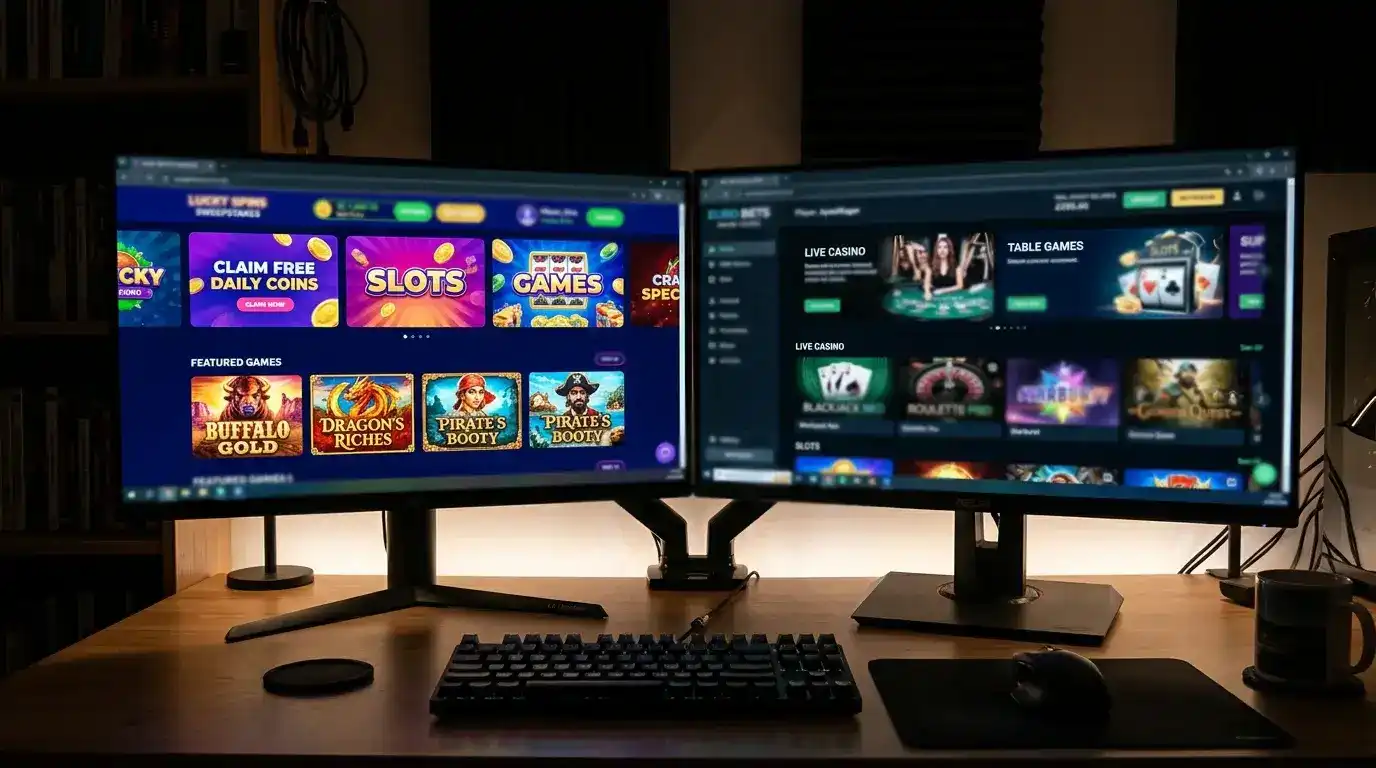
Here’s a number that should give you pause: 90% of sweepstakes casino users believe they’re gambling. That’s from a 2025 AGA survey of 2,250 players conducted by Interpret Research. Ninety percent of people using a product that is legally classified as “not gambling” believe they’re doing exactly that. And according to the same data, 69% of sweepstakes casino players specifically describe these platforms as places to bet real money. The gap between the legal classification and the user experience is enormous, and understanding it is the starting point for any honest comparison of these two categories.
I don’t say this to condemn sweepstakes casinos — I’ve spent nine years analyzing them and they serve a genuine function in the US gaming market. But any comparison that glosses over the perception gap is doing the reader a disservice. The two formats differ in consequential ways across every dimension worth examining: licensing, currency mechanics, game selection, player protections, and market positioning. Some of those differences favor sweepstakes casinos; many favor licensed online casinos. The right choice depends entirely on what you’re actually trying to get from a gaming platform.
Licensing and Regulation: Who Has Oversight?
Regulated online casinos operate under state-issued gambling licenses. In states where online casino gaming is legal — New Jersey, Pennsylvania, Michigan, Connecticut, West Virginia, Delaware — operators must pass background checks, demonstrate financial solvency, submit to regular audits, use certified random number generators, maintain segregated player funds, and comply with responsible gambling requirements including self-exclusion programs, deposit limits, and session time controls. The licensing process is expensive and slow by design: it filters out operators who aren’t serious about compliance.
The regulatory apparatus generates real numbers. Licensed US casino and gambling operators collectively remitted $15.9 billion in state tax revenue in 2024 — a record — according to iGaming Business. That tax revenue funds state programs; it’s also a figure the sweepstakes casino sector contributes essentially nothing to, which is a central argument in legislative debates about whether sweepstakes casinos should face the same regulatory requirements.
Tres York, VP of Government Affairs at the American Gaming Association, put the contrast starkly in 2025: these operators, he said, “present themselves as legitimate, regulated platforms but operate outside the law and regulation.” His framing is politically charged — the AGA represents licensed operators with competitive interests — but the factual core is accurate. Sweepstakes casinos do not hold gambling licenses. They are not regulated by gambling authorities. They are not audited by state gaming control boards. They operate under a promotional sweepstakes framework that was designed for magazine contests, not for persistent digital gaming platforms generating billions in annual revenue.
What does the absence of regulation mean in practice? Sweepstakes casino game outcomes are determined by RNG systems, and reputable platforms use certified third-party testing of those systems — but the certification is voluntary, not required. A sweepstakes casino that chooses not to have its RNG audited faces no legal consequence. Licensed casinos have no such choice. Sweepstakes casino financial stability isn’t independently verified; licensed casinos must demonstrate to regulators that they have sufficient funds to cover player liabilities. If a sweepstakes casino becomes insolvent, player balances may not be protected — a situation that has occasionally materialized with smaller platforms.
For players in states without licensed online casinos, this distinction is somewhat academic — your only option for accessing casino-style games digitally is the sweepstakes format. For players in states with regulated iGaming, it’s a genuine choice worth understanding before you commit time and money. The full picture of how state legal frameworks affect sweepstakes casino access is detailed at 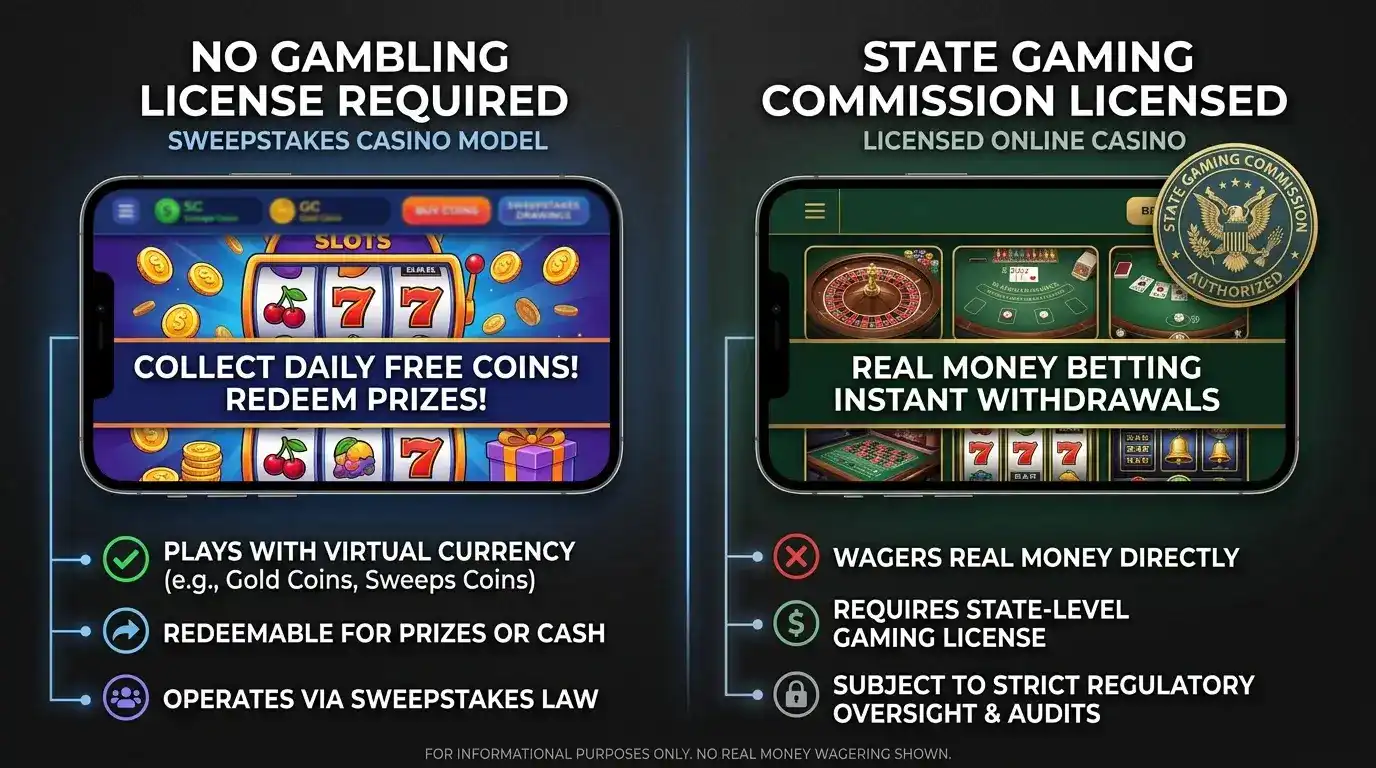 the sweepstakes casino legal states guide.
Real Money vs. Virtual Currency: How Each Model Works
The fundamental operational difference between the two formats is how money flows in and out. At a licensed online casino, the transaction is direct: deposit real dollars, play with real dollars, withdraw real dollars. Your account balance is denominated in the same currency as your bank account. There’s no translation layer.
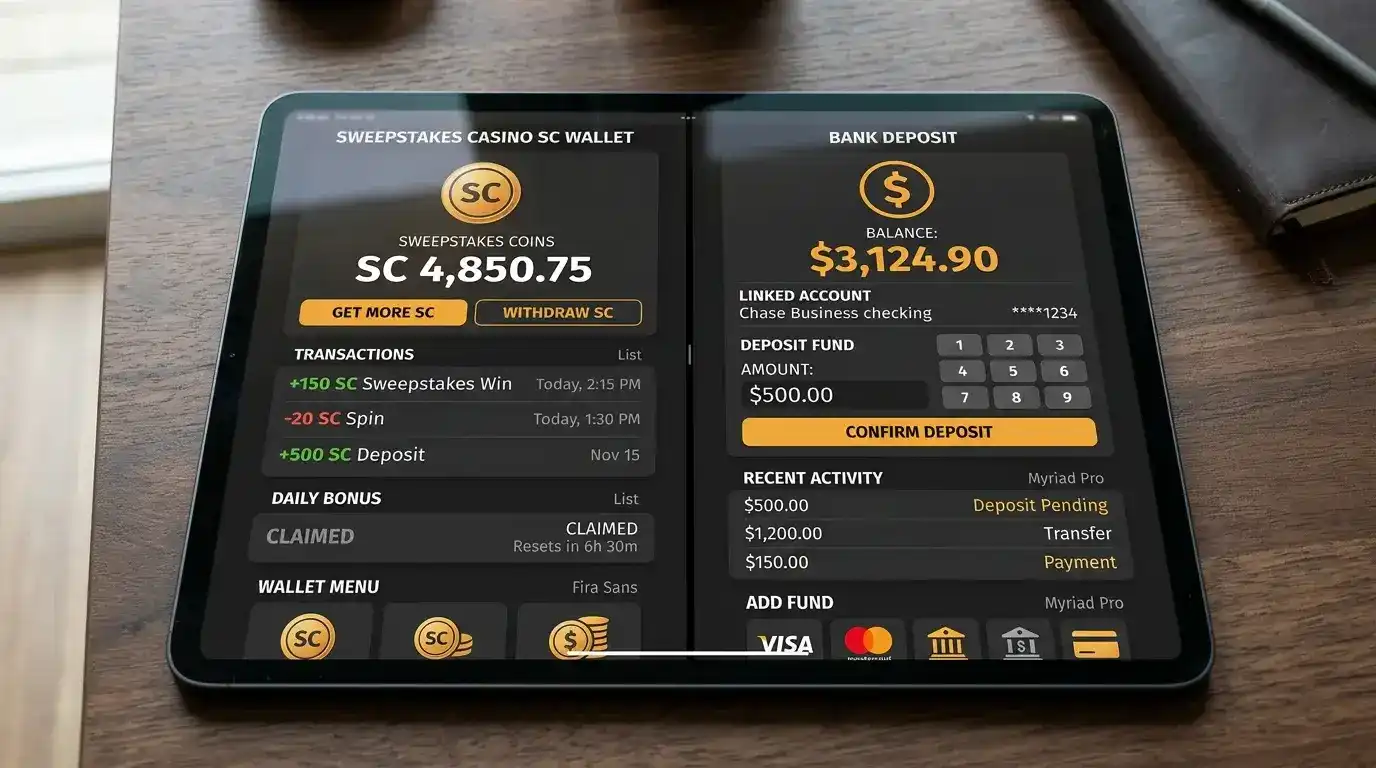
At a sweepstakes casino, you never deposit money in exchange for gameplay directly. You can buy Gold Coins, but Gold Coins have no monetary value and can’t be redeemed. Sweeps Coins — the prize currency — must be obtained through free channels or as a bonus alongside Gold Coin purchases; they’re never the direct product of a purchase. This separation is the legal architecture that keeps sweepstakes casinos outside gambling law, and it has real experiential implications.
The player experience of “winning” is fundamentally different under each model. At a licensed casino, winning $100 means your account balance increases by $100 you can withdraw. At a sweepstakes casino, winning 100 SC means you’ve accumulated $100 in redemption-eligible prize value — contingent on completing playthrough requirements, meeting the minimum redemption threshold (typically 50 SC), passing KYC verification, and the payout request being processed. That’s a longer chain of contingencies between “winning” and “having money in your bank account.”
Research consistently shows that 68% of sweepstakes casino players name winning real money as their primary motivation for playing — nearly identical to the 67% of real-money iGaming players who say the same. That parallel motivation profile, combined with the 90% perception-of-gambling figure, suggests the player experience of “chasing wins” operates essentially identically in both formats. This has obvious implications for problem gambling risk — the psychological and behavioral patterns appear similar even when the legal classification and financial exposure differ.
The practical financial exposure is genuinely different, and this distinction matters. At a licensed casino, you can lose deposits. If you spend $500 on Gold Coins at a sweepstakes casino — money you’ve genuinely spent — you’ve lost $500 even though you never “deposited” it in the traditional gambling sense. The dual-currency structure doesn’t make Gold Coin purchases risk-free; it makes them legally categorized as retail purchases rather than gambling wagers. For some players, this distinction has psychological salience. For many, it doesn’t.
Game Selection: Slots, Table Games, and Live Dealer Availability
Nine years ago, the game selection gap between sweepstakes and licensed casinos was enormous. Sweepstakes platforms offered simple slot simulations; licensed casinos offered hundreds of titles from the leading software developers. That gap has closed substantially.
Today’s major sweepstakes casinos offer libraries running to hundreds of slot titles, often from the same studios that supply real-money platforms — Pragmatic Play, NetEnt, and others license their content to sweepstakes operators as well as licensed casinos in several markets. The visual and mechanical quality of sweepstakes slots is comparable to what you’d find at a licensed platform. Players who came to sweepstakes casinos because they didn’t have access to licensed online gambling are often surprised by the similarity in game quality.
Table games have historically been a weaker area for sweepstakes casinos. Most platforms offer video versions of blackjack, roulette, and video poker, but the selection tends to be narrower than at licensed casinos and the versions available are simpler. Live dealer games — a significant category at licensed online casinos, generating the majority of table game revenue for operators like Evolution Gaming — have only recently started appearing at sweepstakes platforms. A handful of operators now offer live dealer blackjack and roulette using the Sweeps Coin currency, but it remains a limited offering compared to the breadth available through licensed platforms.
Poker is an interesting edge case. Several sweepstakes platforms offer genuine multi-player poker rooms — VGW’s Global Poker is the most prominent example. Multi-player poker isn’t available at most licensed online casinos outside of dedicated poker platforms (PokerStars, WSOP, etc.). For players specifically interested in poker, sweepstakes platforms have filled a gap that the regulated market largely hasn’t.
Sports betting is unavailable at sweepstakes casinos as a category. Sports wagering requires specific licensing that sweepstakes operators don’t hold and couldn’t easily acquire given their operational model. Players who want sports betting alongside casino games need to use licensed sportsbook and casino products.
Jackpot mechanics are present at some sweepstakes platforms, with progressive jackpots linked across multiple players’ coin wagering. 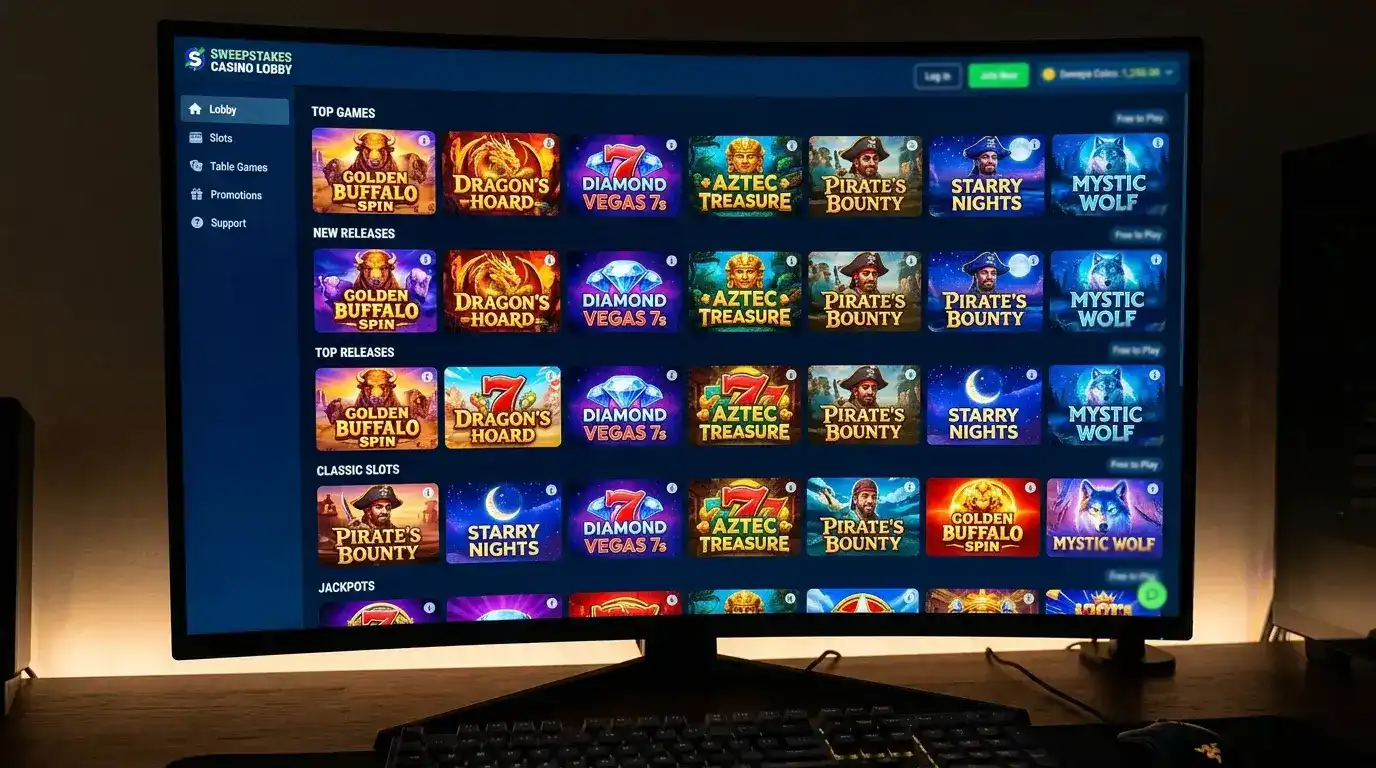 The scale of these jackpots is smaller than what you’d find on networked progressive slots at licensed casinos — a consequence of the different financial scale and jackpot seeding mechanics — but they do exist and do pay out. Some sweepstakes platforms have highlighted multi-thousand-SC jackpot redemptions as part of their marketing, and those claims are generally verifiable through player community reports.
Player Protections: What You Get and What You Don’t
This is where the comparison is most consequential, and where I’m most direct with players who ask me which format they should use.
Licensed casinos are legally required to offer specific player protection tools: deposit limits (daily, weekly, monthly), session time limits with mandatory break reminders, reality checks, self-exclusion programs with multi-year or permanent options, and mandatory exclusion from responsible gambling databases when requested. These requirements aren’t suggestions; operators that fail to implement them face license revocation. They’re funded by a portion of the tax revenue mentioned earlier.
Sweepstakes casinos are not required to offer any of these tools. The AGA’s research framed it precisely: “Despite operating outside the regulated market, sweepstakes casinos position themselves in a way that mirrors legitimate licensed gaming operators. The result: most players treat them exactly like regulated gambling platforms — without the safety mechanisms that regulated markets require.” That’s accurate. Most established sweepstakes platforms do offer some voluntary self-exclusion options and deposit-limit-equivalent tools on Gold Coin purchases. But they’re implemented inconsistently, don’t connect to shared exclusion databases, and have no regulatory teeth.
Problem gambling resources and referrals are another area where the regulated model leads. Licensed casinos are required to prominently display responsible gambling resources and contribute to state problem gambling programs. Sweepstakes casinos have no such requirement. Some platforms display resources voluntarily; many don’t.
This isn’t an argument that sweepstakes casinos are inherently more dangerous. Plenty of players use them without problem. But for anyone who has experienced problems with gambling or gaming behavior, the absence of regulatory protection structures at sweepstakes platforms is a meaningful risk factor that shouldn’t be minimized. The legal classification as “not gambling” doesn’t change the psychological and behavioral mechanics of extended gameplay with prize-eligible currencies.
Dispute resolution is another area where regulated platforms have structural advantages. If you have a dispute with a licensed casino in New Jersey, Pennsylvania, or Michigan, you have access to the state gaming control board as an independent arbitration body. If you have a dispute with a sweepstakes casino, your recourse is the platform’s own customer service and, theoretically, civil litigation. No regulatory body has jurisdiction to mediate the dispute. Most established sweepstakes platforms handle disputes reasonably — the competitive environment creates incentives to maintain good player relations — but the absence of independent oversight creates asymmetry that matters when things go wrong.
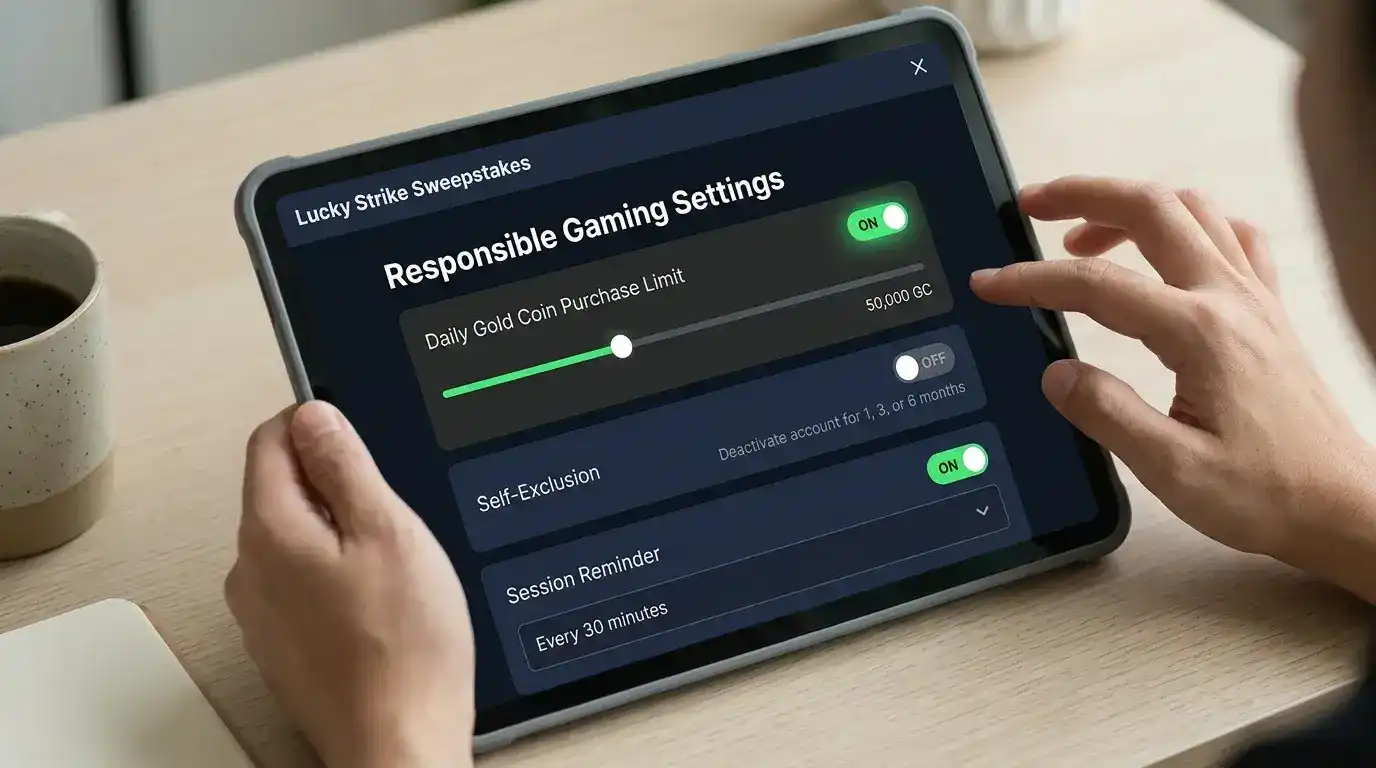
Transparency around game odds is also regulated at licensed casinos. Many jurisdictions require licensed operators to publish the theoretical return-to-player (RTP) percentages for their games. Sweepstakes casinos aren’t required to disclose RTP percentages. Some do it voluntarily as a trust signal; most don’t. For players who make informed decisions based on RTP data, this is a real information disadvantage at sweepstakes platforms.
Market Size Comparison: How Sweepstakes Stacks Up Against iGaming
In 2024, sweepstakes casinos surpassed the revenue of licensed online casinos in the United States for the first time — a milestone that caught many industry observers off-guard. The US market generated over $10.6 billion in Gold Coin purchase volume that year, with net gaming revenue of approximately $3.4 billion, according to Eilers & Krejcik Gaming’s research for the Social Gaming Leadership Alliance. Licensed iGaming states collectively generated less net gaming revenue than that.
The 2025 figures push the comparison further: EKG projected total sweepstakes purchase volume at $14.31 billion for the year. Licensed online casinos across all legal states didn’t come close to matching that figure. The growth trajectory has been extraordinary — a 44% compound annual growth rate over the 2022 to 2025 period. Sweepstakes casinos are no longer a niche product filling gaps in the regulated market; they’re the dominant form of online casino gaming in the United States by volume.
This market position reversal has enormous political consequences, which explains much of the legislative activity described in legal state analyses. When sweepstakes casinos were small, the regulated industry’s competitive complaints about unlicensed operators could be dismissed as incumbents protecting turf. When sweepstakes casinos are larger than the regulated sector, the complaints become more politically salient. The $15.9 billion in tax revenue from licensed operators in 2024 is a number that legislators can compare directly against the essentially zero tax contribution from sweepstakes platforms generating comparable economic activity.
For players, market size data is relevant in one specific way: large, financially stable platforms are more reliable on redemption. A platform generating billions in annual revenue has the financial infrastructure to process thousands of simultaneous redemption requests. Smaller platforms operating in the long tail of the 140-plus market may not. Market concentration around established operators — even as new entrants continue to launch — is part of what makes the redemption environment more predictable than it was five years ago.

Which Is Right for You? A Decision Framework
The choice between sweepstakes and licensed online casino formats isn’t complicated once you know what you’re actually optimizing for.
If access is your primary constraint — you’re in a state without licensed online casino gaming — sweepstakes is your realistic option for casino-style play. Thirty-seven states have no regulated online casino market. Sweepstakes casinos exist as the only digital casino product legally accessible to most Americans, and for those players, the comparison with licensed casinos is somewhat theoretical. The regulated iGaming map in the US is expanding slowly; New York, for instance, has approved online casino gaming in principle but hasn’t yet launched. Until those markets open, sweepstakes fills the gap.
If you want to play with money you’ve deposited, tracking real wins and losses in real currency with real-time visibility, licensed online casinos in states where they’re legal are the appropriate format. The deposit-to-play direct model is cleaner and more transparent than the dual-currency structure. There’s no translation layer, no playthrough requirement before your winnings are accessible, and your balance is denominated in dollars rather than coins that need to be exchanged.
If free play is appealing — you want to experience casino-style games without financial risk, or you’re interested in the prize redemption potential of Sweeps Coins but don’t want to purchase Gold Coins — sweepstakes casinos are purpose-built for this use case. The free-coin pathways through login bonuses, promotions, and AMOE are genuine, not marketing fiction. A disciplined free-play-only approach is a viable way to use these platforms without any real financial exposure. No licensed casino offers this option; real-money deposits are the only way in.
If player protections matter to you — if you’ve had issues with problem gambling previously, or you want the confidence of playing on a platform with regulatory oversight — licensed casinos in legal states are the choice with stronger structural safeguards. The voluntary protections at sweepstakes platforms, while often good faith efforts, don’t carry the same reliability as mandated regulatory requirements.
The market has room for both formats, and the overlap in player audience is real — the same person might use a sweepstakes platform for free casual play and a licensed casino for serious deposit play. These aren’t mutually exclusive choices. Understanding what each format is and isn’t, rather than treating them as equivalent, is what allows you to make that call intelligently.

Frequently Asked Questions
The full picture is in our complete guide to US sweepstakes casinos.
Where each model is allowed: the legal states map.
Prepared by the SweepEdge editorial staff.